

Range hood size is the specification most people get wrong twice. First they buy a hood the same width as the cooktop, which means smoke rolls off the front edge every time something sears. Then they chase a big CFM number to compensate, connect it to a duct that cannot carry that much air, and end up with a loud fan that moves less than the quiet one would have.
A hood has four numbers that need to agree with each other: width, mounting height, airflow, and duct diameter. Get those four talking and a modest hood clears a kitchen quietly. Get them fighting and no amount of money fixes it. Here is how to set each one.
Width: Go Wider Than the Cooktop
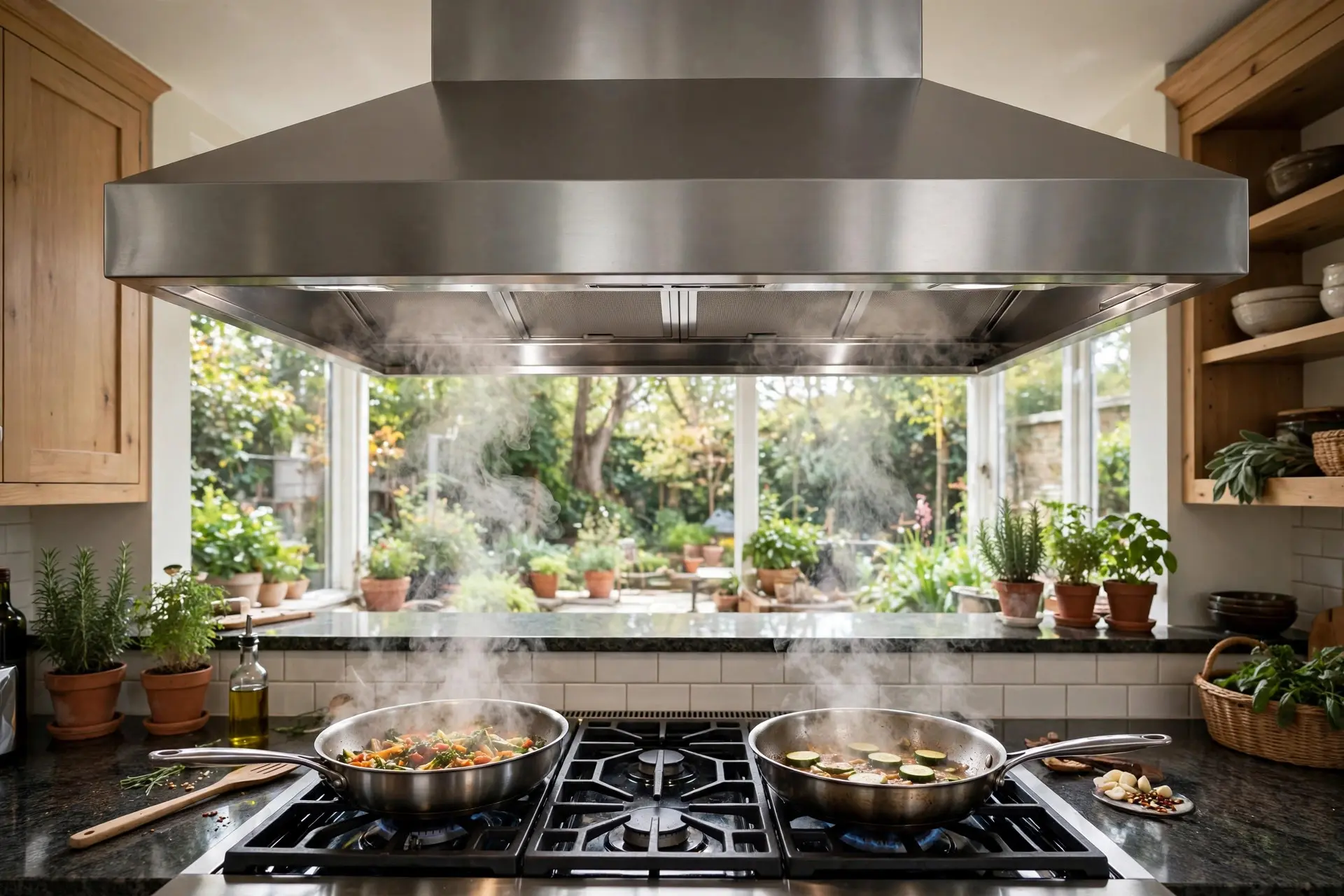
Hot air rising off a pan does not travel straight up. It spreads outward as it rises, so by the time the plume reaches the hood it is wider than the burner that produced it. A hood matched exactly to the cooktop catches the middle of that plume and lets the edges escape into the room, where they land on your cabinets as a film you will be scrubbing off in two years.
The standard fix is to go 6 inches wider than the cooktop, 3 inches on each side (Proline Range Hoods). So a 30 inch cooktop takes a 36 inch hood, and a 36 inch cooktop takes a 42 inch hood.
Matching width exactly is acceptable when the hood sits under a cabinet in a tight galley and you genuinely have no wall to spare. It is a compromise, not a choice, and you should expect to run the fan longer.
Depth matters too, and it gets ignored. If the cooktop sits in an island, the hood width also has to sit comfortably against the island seating measurements on the other side. The hood needs to cover the front burners, not just the back ones. Most cooking happens on the front, and a shallow hood that stops halfway across the cooktop is catching steam from the pot you are not using. If the hood depth is less than the cooktop depth, plan to mount it lower or accept the loss.
Mounting Height: 28 to 36 Inches

For indoor hoods the working range is 28 to 36 inches above the cooking surface. Outdoor hoods sit higher, 36 to 42 inches, because outdoor grills throw more heat. Notably, this range does not change with fuel type or with how powerful the fan is (Proline Range Hoods). Always check the manufacturer’s own installation sheet, since a specific model may narrow that range.
Within the range, the tradeoff is straightforward. Lower captures better, because the plume has less room to spread before it reaches the filters. Higher gives you head clearance and a better view of the back burners.
- Choose 28 to 30 inches if you cook with high heat often, use a wok, or the household is on the shorter side.
- Choose 30 to 32 inches for most kitchens. This is the default for a reason.
- Choose 33 to 36 inches if someone tall cooks regularly, or the hood is a statement piece you do not want cutting across sightlines.
Test it before the installer drills. Stand at the cooktop, hold your hand where the bottom edge of the hood will be, and go through the motion of lifting a stockpot off a back burner. If your knuckles find the hood, you are too low.
Island hoods follow the same measurements but read very differently in a room, because they hang in open space rather than against a wall. The visual logic is closer to pendant lighting, and if you are coordinating both over the same island, our guide to pendant light height over an island covers how to keep the two from competing.
CFM: Size It to the Cooktop, Not the Showroom
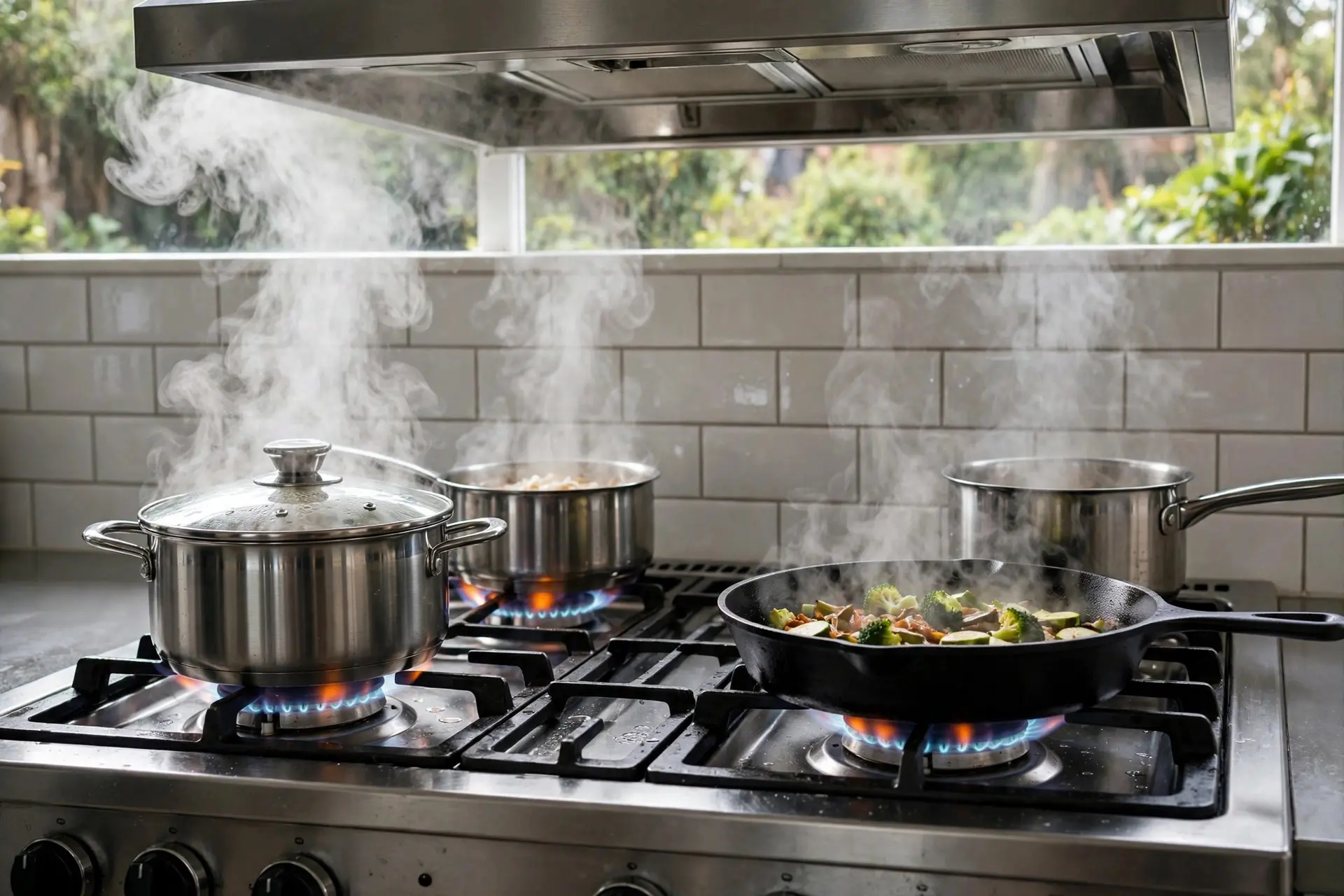
CFM is cubic feet per minute, the volume of air the fan moves. Bigger is not better. An oversized fan in a tight house pulls air it cannot replace, which is a real problem we will get to.
Two widely used formulas, depending on what you cook on:
- Electric or induction: about 100 CFM per linear foot of cooktop width. A 30 inch cooktop is 2.5 feet, so roughly 250 CFM.
- Gas: about 1 CFM per 100 BTU of total burner output. A 40,000 BTU range calls for around 400 CFM.
- Island installations: add 100 to 200 CFM to whichever number you land on, because there is no wall helping to contain the plume.
Those figures come from The Range Hood Store. Add your burner BTUs from the appliance spec sheet rather than guessing. A professional style range with a 22,000 BTU power burner reaches a much higher total than the six burner count suggests.
One more thing worth knowing: the CFM printed on the box is measured with no duct attached. Your real number will be lower, sometimes considerably. Which brings us to the part that decides everything.
The Duct Is the Actual Bottleneck

You can buy a 900 CFM hood and get 400 CFM of performance. This happens constantly, and it is the single biggest gap between what people pay for and what they get.
Three things choke a duct run.
Diameter. Never reduce below the hood’s outlet size. If the hood ships with an 8 inch collar and the existing run is 6 inch, you have not saved money, you have bought a fan that cannot breathe. Reducing diameter raises resistance sharply, and the fan responds by working harder and getting louder while moving less air.
Length and bends. Straight and short wins. Every 90 degree elbow adds meaningful resistance to the run, and a path with three or four turns can cost you a large share of the rated airflow. Long or twisty duct runs measurably reduce performance (The Range Hood Store), which is why a hood on an exterior wall with a two foot straight run outperforms a stronger hood routed through the ceiling and across the house.
Material. Smooth rigid metal duct, every time. Flexible corrugated duct is easier to install and its ridged interior creates turbulence along the entire run. If someone proposes flex duct for a range hood, ask for rigid instead.
Work out the duct path before you choose the hood. If the only available route involves five elbows and 25 feet, buy a modest hood and route it well rather than a powerful one routed badly. This is the sequencing decision that separates a kitchen that stays clean from one that does not, and it belongs in the plan alongside the other early calls like choosing a backsplash that will sit directly behind the cooktop.
Makeup Air: The Requirement Nobody Warns You About

A hood pulls air out of the house. That air has to be replaced from somewhere. In an older leaky house it seeps in around windows and doors and nobody notices. In a modern airtight house, a strong fan can pull the interior into negative pressure.
That matters for two reasons. Doors get harder to open, which is annoying. More seriously, negative pressure can pull combustion gases backward down the flue of a water heater, furnace or fireplace, which is a safety issue rather than a comfort one.
This is why hoods rated above 400 CFM commonly trigger a makeup air requirement in local building code (The Range Hood Store). A makeup air system is a damper and duct that lets replacement air in when the hood runs, and it is not a trivial add on. It needs its own duct, often a tempering heater in cold climates, and wiring that links it to the hood.
Check your local code before you order. Thresholds vary, and finding out at inspection is expensive. If you are close to the line, a 390 CFM hood on excellent ducting often beats a 600 CFM hood plus a makeup air system you did not budget for.
Ducted or Recirculating, Honestly
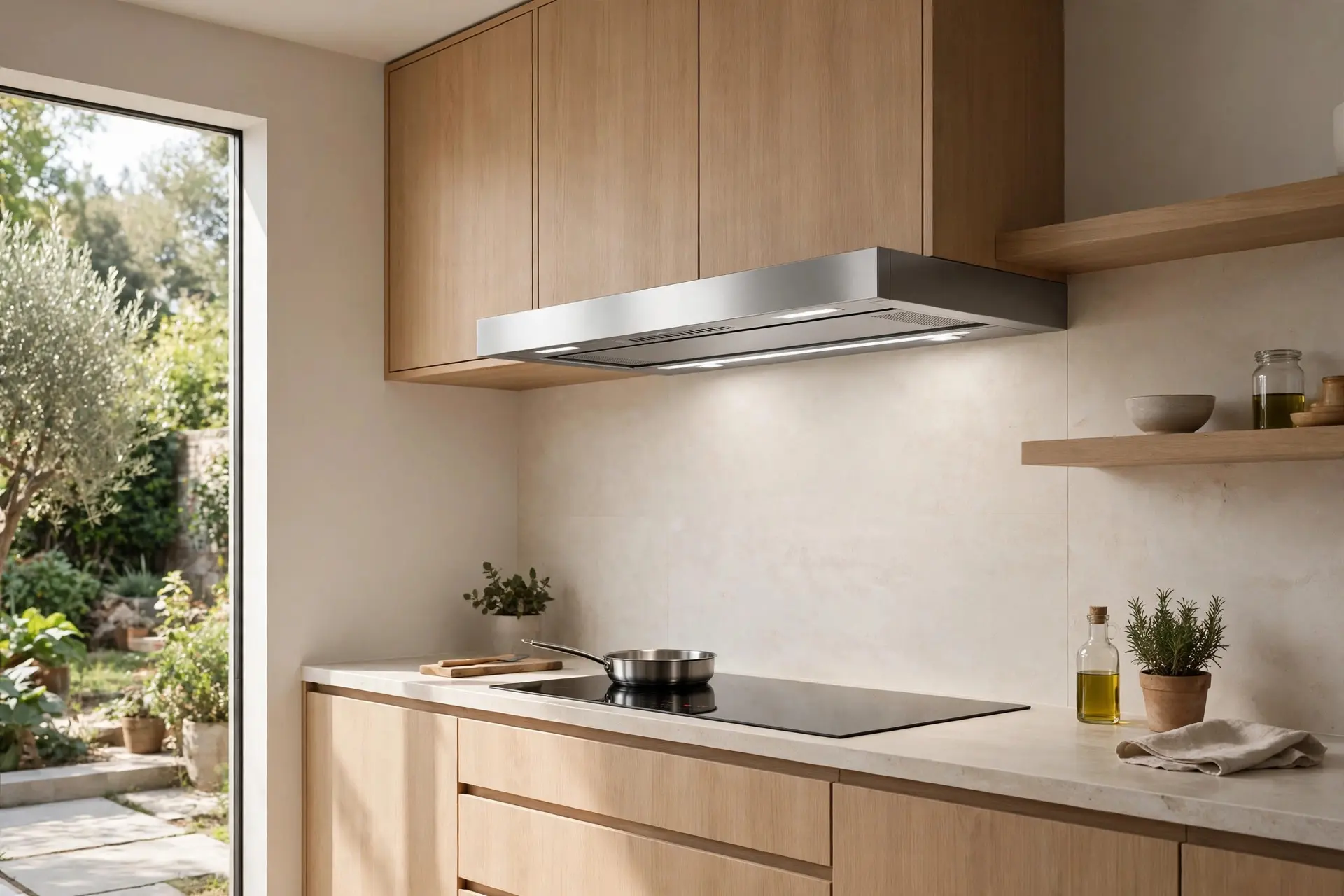
A recirculating hood pulls air through a charcoal filter and blows it back into the kitchen. It removes some grease and some odour. It removes no heat, no steam and no combustion byproducts, because none of it leaves the room.
Sometimes there is no alternative. Interior apartments and condos often cannot run a duct to the outside. If that is your situation, buy a recirculating hood with a large filter area, change the charcoal on schedule (typically every 6 to 12 months depending on use), and manage expectations.
If you can duct outside, duct outside. The difference is not subtle.
Noise, and Why the Quiet Setting Is a Trap

Hood noise is rated in sones. Roughly, 1 sone is a quiet refrigerator hum and 8 sones is loud enough to stop conversation. Most hoods list sones at maximum speed, which is the number that matters, because a hood you will not run on high is a hood that is not working.
Two ways to buy quiet. Choose a hood with a larger, slower fan rather than a small fast one at the same CFM. Or choose an inline or exterior blower, where the motor sits in the duct run or on the roof instead of above your head. Exterior blowers are the quietest option available and cost more to install.
Also run the hood before you start cooking, not after the pan is smoking. A hood that is already moving air catches the plume from the first second. This one habit does more for kitchen air than 200 extra CFM.
Frequently Asked Questions

What range hood size do I need for a 30 inch stove?
A 36 inch hood, which gives you 3 inches of overhang on each side. If cabinet space makes that impossible, a 30 inch hood will work under protest and you should mount it toward the lower end of the height range to compensate.
How high should a range hood be above the cooktop?
Between 28 and 36 inches for an indoor hood, with 30 to 32 inches suiting most kitchens. Outdoor hoods go higher, 36 to 42 inches. The range does not change based on gas versus electric, but the manufacturer’s installation instructions for your specific model take priority.
Is more CFM always better in a range hood?
No. Above 400 CFM you may legally need a makeup air system, high CFM fans are louder, and the rated number is only achievable with adequate ducting. A correctly sized hood on short, straight, full diameter rigid duct outperforms an oversized one on a poor duct run.
Can I use a 6 inch duct for an 8 inch range hood?
You should not. Reducing the duct below the hood’s outlet diameter raises resistance significantly, so the fan gets louder while moving less air. If the existing run is 6 inch and cannot be enlarged, buy a hood designed for a 6 inch outlet instead of throttling a larger one.
Do range hoods need to be vented outside?
Ducted to the outside is far more effective, because it removes heat, steam and combustion byproducts rather than just filtering grease. Recirculating hoods are a reasonable fallback where no exterior route exists, such as an interior apartment, provided you replace the charcoal filters on schedule.
Getting the Four Numbers to Agree

Start at the cooktop. Add 6 inches for width. Set the height between 28 and 36 inches based on who cooks and how hot. Calculate CFM from burner output rather than ambition. Then look hard at the duct run, because that is the number that quietly overrules the other three.
A hood sized this way is usually cheaper and quieter than the one you were about to buy, and it will keep the grease off your cabinets, which was the whole point.