

Most people choose a headboard because they liked it in a photo. Then it arrives, goes against the wall, and something feels off. Either the piece disappears behind a pile of pillows, or it looms over the bed and makes the ceiling feel lower than it is. Headboard height is the measurement that decides which of those you get, and it is the one number almost nobody checks before ordering.
The good news is that this is solvable with a tape measure and about ten minutes. Below are the real numbers, the two different ways height gets listed, and the one test that catches problems before your money leaves your account.
The Two Heights, and Why Retailers Only Tell You One

A headboard has an overall height, measured from the floor to the top edge, and an effective height, measured from the top of your mattress to the top edge. Product pages almost always list the overall height. Your eye only ever sees the effective height.
That gap is bigger than people expect. Say you buy a headboard listed at 48 inches. Your platform bed sits 14 inches off the floor and your mattress is 12 inches thick. The top of your mattress is at 26 inches. Only 22 inches of that headboard shows. Put a standard bed frame with a box spring under the same mattress and your mattress top climbs to 30 or 32 inches, leaving you 16 to 18 inches of visible headboard. Same product, very different look.
So the first thing to measure is not the wall. It is the distance from your floor to the top of your made mattress. Write that number down. Everything else keys off it.
Standard Headboard Widths by Bed Size

Width is the easier half of the problem because it is tied to mattress size. Headboards are normally the same width as the mattress or two to four inches wider, and published size charts put the common widths at roughly:
- Twin: about 41 inches
- Full: about 56 inches
- Queen: about 62 inches
- King: about 80 inches
- California king: about 74 inches
A headboard two to four inches wider than the mattress is usually the better buy. It gives your fitted sheet somewhere to disappear, it hides the mounting brackets, and it reads as intentional rather than slightly short. A headboard narrower than the mattress almost never looks right, because the mattress corners stick out past it.
One exception worth knowing. If you have an adjustable base, check whether the headboard is rated for it. Many bracket-mounted headboards bolt to a standard frame and have no way to attach to an adjustable base, so you end up needing a freestanding or wall-mounted version instead.
The Three Headboard Height Ranges

Rather than chasing one perfect number, it helps to know what each range actually does to a room.
Low: 10 to 16 inches above the mattress
This is the range for rooms where the wall has other jobs. Low headboards keep sight lines open, which is why they work under a window, beneath a sloped ceiling, or in a room under about 10 by 10 feet where a tall piece would dominate. The tradeoff is real: at this height your pillows will cover most of the headboard once the bed is made, so the piece becomes a quiet edge rather than a focal point. Choose it for function and finish, not for drama.
Medium: 24 to 32 inches above the mattress
This is the range most queen and king beds should land in, and it is the safest choice if you are unsure. It clears a normal pillow stack by a visible margin, it gives you something to lean against when you read, and it still leaves plenty of bare wall above. On a queen bed with a 26 inch mattress top, a medium headboard puts the top edge somewhere around 50 to 58 inches from the floor, which sits comfortably under an eight foot ceiling.
Tall: 36 inches and up above the mattress
Tall headboards are architecture. They replace art, they anchor a big room, and they look best on a king bed with a ceiling of nine feet or more. They are also the range where mistakes get expensive, because a tall headboard in a small room with an eight foot ceiling crowds everything and leaves no wall to breathe. If you want the tall look in a standard room, a better move is a medium headboard with a fabric or paneled treatment on the wall above it, which gives you the height without the bulk.
Match the Height to Your Ceiling

The number that keeps a room from feeling squashed is the bare wall left above the headboard. Aim for at least 12 to 18 inches of visible wall between the top of the headboard and the ceiling, or between the headboard and the bottom of any crown molding.
Worked backward from common ceiling heights, that means the top of the headboard wants to land somewhere near:
- 8 foot ceiling (96 inches): top of headboard at 50 to 60 inches from the floor
- 9 foot ceiling (108 inches): 56 to 70 inches from the floor
- 10 foot ceiling and up: 65 to 80 inches, and this is where a genuinely tall headboard earns its keep
Subtract your mattress top height from those figures and you have your target effective height. On a 26 inch mattress top under an eight foot ceiling, 50 to 60 inches overall means 24 to 34 inches of headboard showing, which is exactly the medium range.
The Pillow Test

Here is the step that catches most bad headboard purchases, and almost no buying guide mentions it. Go make your bed the way you actually make it. Then measure from the top of the mattress to the top of your pillow line.
A pair of standard pillows lying flat comes in around 6 to 8 inches. Propped upright against the wall they reach 12 to 16 inches. Add euro shams behind them and you are at 18 to 22 inches. That is the height your headboard has to clear before anyone sees any of it.
The working rule: your effective headboard height should be at least 10 inches taller than your made pillow line. If you keep a simple two pillow bed, a 24 inch effective height is plenty. If you build a five pillow bed with shams, you need 30 inches or more, or the headboard is decoration you never see.
This is also the reason people who love a heavily layered bed usually end up happier with a tall upholstered headboard. It is not about drama. It is about the pillows not eating it.
What Else Is Living on That Wall

Headboard height is rarely a solo decision. Three things commonly collide with it.
Art or a mirror above the bed. Leave 6 to 10 inches between the top of the headboard and the bottom of the frame, and keep the art narrower than the headboard so the grouping reads as one block. Now add it up: headboard top, plus 8 inches of gap, plus the height of the art, plus 12 inches of clearance under the ceiling. If that total is more than your ceiling height, the headboard has to come down.
Wall sconces. A reading sconce wants the bottom of the shade just above eye level for someone sitting up in bed. Once a headboard goes past roughly 30 inches above the mattress, it starts fighting that position, and the sconce has to move outboard of the headboard or onto the ceiling. Decide the headboard first, then place the sconces.
A window behind the bed. Either stop the headboard clearly below the sill or run it clearly past the window. A headboard that cuts a window in half looks like an accident. If you are also planning window treatments in that room, the curtain hanging heights that make a room look taller will affect where the rod lands relative to the headboard, so plan them together.
Six Numbers to Write Down Before You Buy
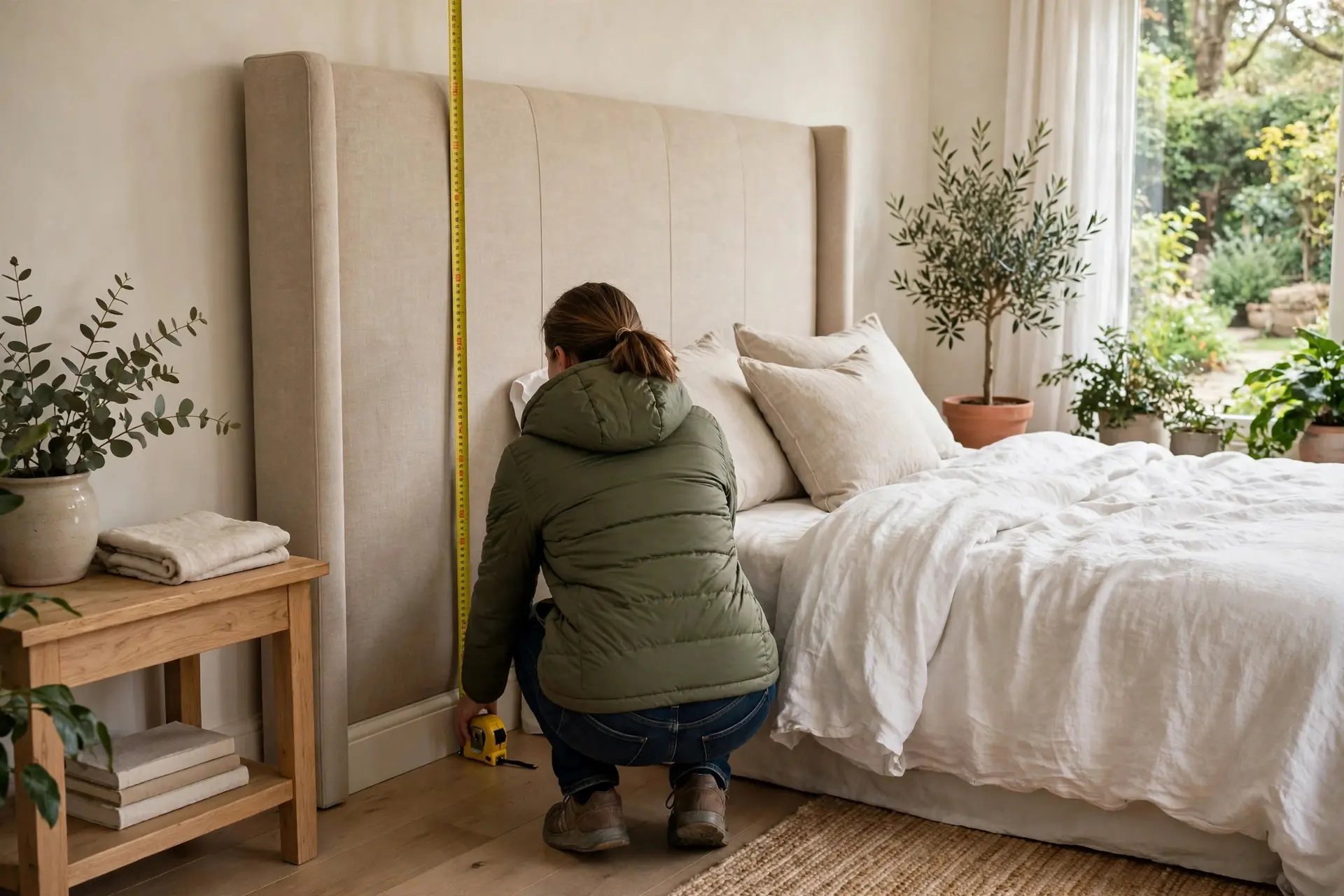
- Floor to the top of your made mattress
- Your made pillow line, measured up from the mattress
- Ceiling height, and the bottom of any crown molding
- Mattress width, so you can aim two to four inches wider
- Wall width available, including anything the nightstands need
- How far the headboard will push the bed off the wall
That last one surprises people. A thin metal or wood headboard adds an inch or two to the bed’s footprint. A deeply upholstered or tufted headboard can add 3 to 6 inches once you account for the padding and the mounting hardware. In a tight room, those inches come straight out of your walkway, so factor them into the layout the same way you would when checking whether a rug fits around a queen bed.
Mistakes That Show Up Again and Again

- Ordering by overall height and forgetting the mattress. A 48 inch headboard behind a tall bed is a short headboard.
- Going tall in a small room with an eight foot ceiling. The room shrinks, not the bed.
- Matching the headboard to the mattress width exactly. Two to four inches wider looks finished; dead even looks slightly wrong.
- Buying before checking the base. Adjustable bases and some platform frames have no bracket points.
- Ignoring nightstand height. If the nightstand top is far above or below the bottom of the headboard, the wall reads as cluttered. Sorting your nightstand styling and proportions at the same time keeps the whole wall consistent.
- Forgetting sloped ceilings. In an attic or dormer room, measure at the exact spot the bed will sit, not in the middle of the room. Rooms with angled ceilings usually need one of the lower ranges, which is covered in more depth in these attic bedroom ideas for sloped ceilings.
Frequently Asked Questions
How high should a headboard be above the mattress?
For most beds, 24 to 32 inches above the top of the mattress is the range that looks balanced and clears a normal pillow stack. Go lower, 10 to 16 inches, if the bed sits under a window or a sloped ceiling. Go to 36 inches or more only if you have a king bed and a ceiling of nine feet or higher.
Is a tall headboard a bad idea in a small bedroom?
Usually, yes, though not because of the bed. The problem is the wall. A tall headboard in a small room with a standard ceiling leaves almost no bare wall above it, and that lack of breathing room is what makes the room feel tight. A medium height headboard in a light color, with the wall above left plain, gives you presence without the squeeze.
Can a headboard be wider than the mattress?
Yes, and two to four inches wider is the normal target. Wider than that starts to eat into nightstand space, so measure the whole wall before going beyond about six inches over. Narrower than the mattress is the version to avoid, because the mattress corners will stick out past the headboard.
Does a low headboard work with a king bed?
It can, but a king bed is 80 inches wide, so a low headboard on it becomes a long horizontal band. That reads well in a modern or low-slung room and poorly in a traditional one. If you go low on a king, give the headboard some visual weight through material or color rather than height.
What if I measure and nothing on the market fits?
This happens most often with tall beds and low ceilings. Two workarounds: mount the headboard to the wall instead of the frame, which lets you set the exact height you want, or skip the headboard and treat the wall itself with paneling, a fabric panel, or paint carried up to a set height. Both give you the finished edge a headboard provides without fighting the measurements.
The Short Version

Measure your mattress top height, measure your made pillow line, and pick a headboard that clears that pillow line by at least 10 inches while leaving 12 to 18 inches of bare wall below the ceiling. Buy it two to four inches wider than the mattress. That is the whole method, and it will get you a better result than any amount of scrolling.