

Most televisions in most living rooms are hung too high. Not slightly too high. Six to twelve inches too high, which is enough to leave you tipping your head back through a whole movie and wondering why your neck aches afterwards. The reason is almost always the same: people choose the TV mounting height by standing in the room and staring at the wall, when the only thing that matters is where your eyes sit once you are on the sofa.
Getting this right costs nothing. It takes one measurement before you drill and a little arithmetic. Here is the measurement, the math that turns it into a bracket position, the numbers by screen size, and an honest look at what happens when a fireplace is in the way.
Why So Many TVs End Up Too High

Three habits push screens upward, and they all feel reasonable at the time.
The first is that you install it standing up. When you are on your feet holding a bracket against the wall, a screen at seated eye level looks absurdly low. So you nudge it up until it looks right, then sit down and discover it is not.
The second is furniture. A console or media unit sits on the floor, and there is an instinct to leave a generous gap above it so the two pieces do not crowd each other. That gap is usually where the extra height comes from.
The third is the fireplace, which we will come back to, because it is the single most common reason a TV ends up somewhere your neck will complain about.
The One Measurement That Decides Everything
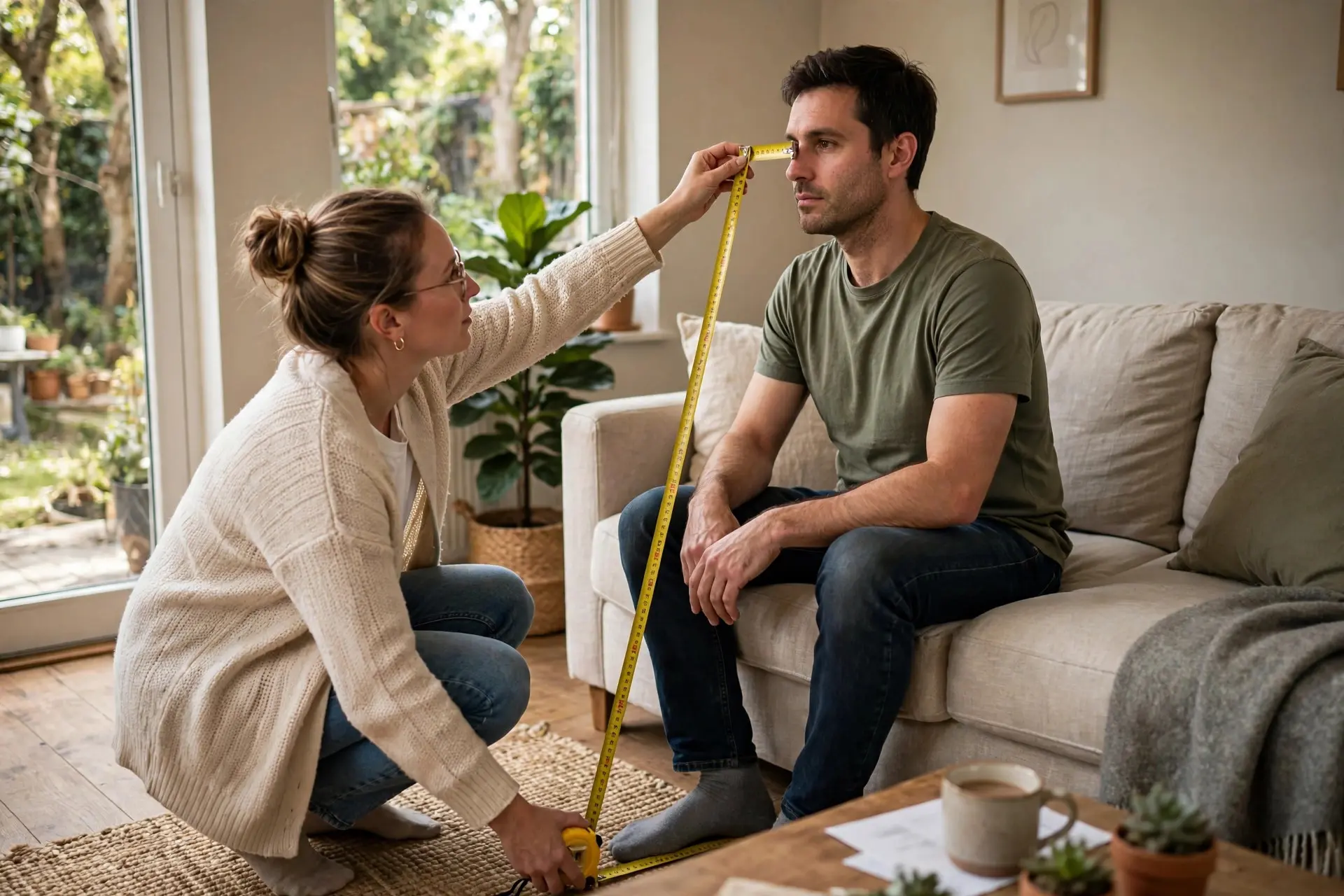
Sit on the sofa the way you actually sit. Not the upright posture you adopt when someone is measuring you. Slouch a little if that is your habit. Then have someone measure from the floor to the center of your eyes.
That number is your seated eye height, and for most adults on most sofas it lands somewhere between 38 and 44 inches. The spread comes almost entirely from the furniture. A firm sofa with an 18 inch seat height puts you noticeably higher than a deep, soft sectional you sink into at 15 inches.
This is why the popular advice to mount every TV with its center at 42 inches is only half useful. It is a fair average, and it will be roughly right in a room with a standard sofa. It will be wrong by five inches in a room with a low modern one.
Turning Eye Height Into a Bracket Position

The target is simple: the center of the screen should sit at or just below your seated eye height. Eyes rest naturally a few degrees downward, so landing the center of the screen up to about three inches below eye level is comfortable. Above eye level is where problems start.
The catch is that you do not mount the center of the screen. You mount a bracket, and the bracket bolts to holes that are rarely at the middle of the panel. So you need one more measurement.
- Lay the TV face down on a blanket and measure the screen height, top edge to bottom edge. Half of that is your half height.
- Measure from the top edge of the TV down to the center of the mounting holes.
- Subtract the second number from the first. That gap tells you how far the mounting holes sit above or below the screen center.
- Take your target screen center height, adjust by that gap, and you have the height for the bracket holes on the wall.
A worked example
Say your seated eye height is 41 inches, so you want the screen center at 41 inches. Your 65 inch TV has a screen height of about 32 inches, giving a half height of 16 inches. The mounting holes sit 20 inches down from the top edge, which is 4 inches below the screen center. So the bracket holes need to go at 41 minus 4, or 37 inches from the floor.
Most wall plates also allow a small amount of vertical adjustment once the TV is hooked on, usually an inch or two. That is your margin for error, not a substitute for measuring.
Typical Heights by Screen Size

If you want a sanity check rather than a custom measurement, mount specialist Vogel’s publishes floor to screen center ranges by size: roughly 39 to 43 inches for a 55 inch screen and 39 to 47 inches for a 65 inch screen in a living room, with the higher end of each range suiting taller seating. Their guidance for a bedroom is different, at around 60 inches from the floor, because you are watching from a reclined position (Vogel’s).
Notice that the screen size barely changes the number. That surprises people, but it follows from the rule. You are aligning the middle of the screen with your eyes, and the middle of the screen is the middle of the screen whether the panel is 55 or 85 inches. A bigger TV grows in both directions from that same point.
What screen size does change is how much wall you need below the center point. An 85 inch TV has a screen height near 42 inches, so with the center at 41 inches the bottom edge lands about 20 inches off the floor. If your console is 24 inches tall, the TV and the furniture are going to collide. That is a sizing problem, not a height problem, and the fix is a lower console or a smaller screen.
Viewing Distance Matters Just as Much

Height and distance work together. A screen that is slightly high feels much worse up close, because the angle your neck has to travel gets steeper the nearer you sit.
A practical working range for mixed viewing is one and a half to two and a half times the screen diagonal. For a 55 inch TV that is roughly 7 to 11 feet. For a 65 inch it is about 8 to 13 feet. Sit closer than the bottom of that range and you start noticing pixel structure on standard content and turning your head to follow action across the screen.
Measure your actual sofa to wall distance before you buy the screen, not after. In a long, thin room the seating is often pushed closer to the TV wall than people realise, which is one of several reasons those layouts need their own approach. If that describes your space, our guide to narrow living room layouts covers how to place seating without creating a corridor.
The Fireplace Problem, Honestly
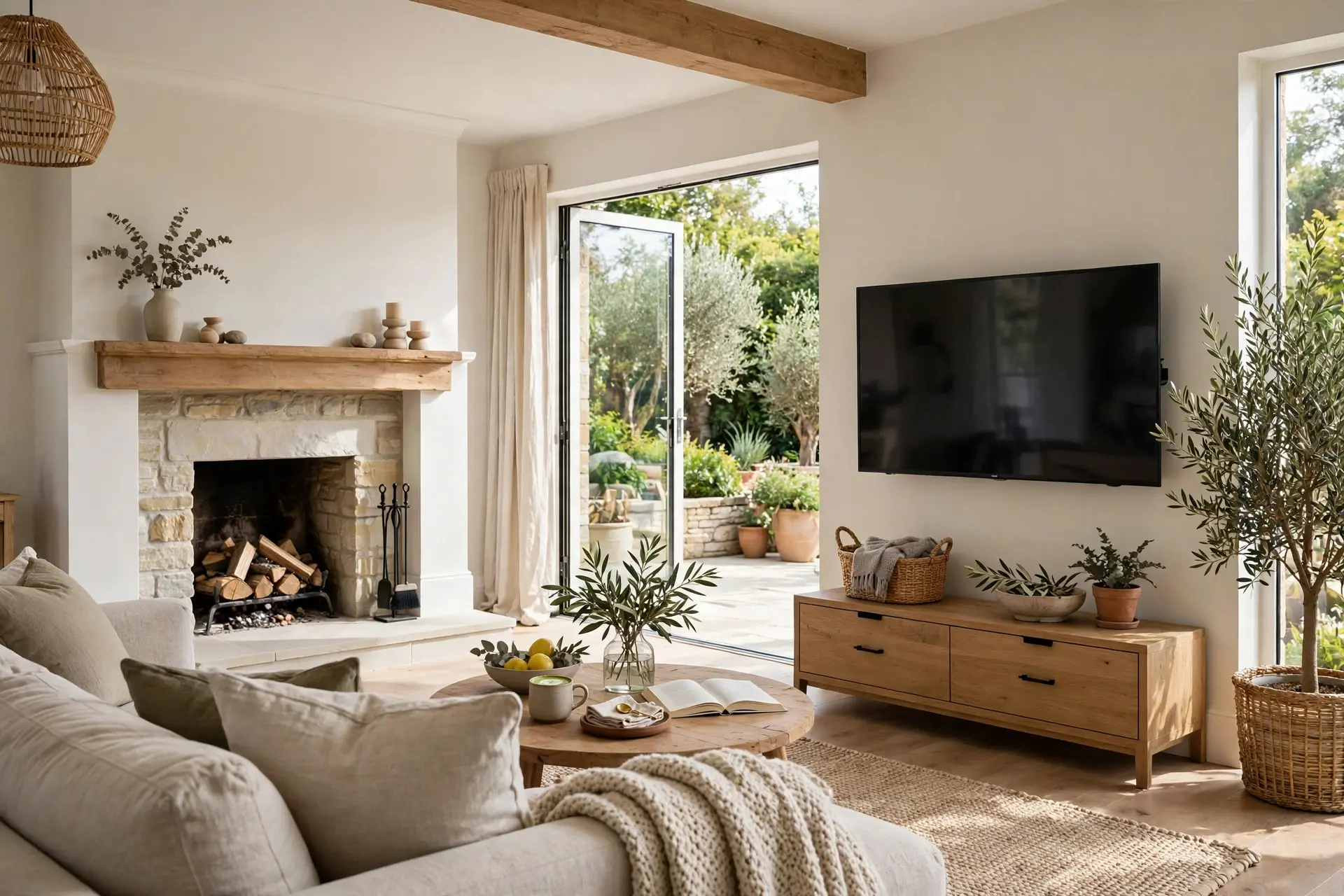
A typical mantel sits 48 to 54 inches from the floor. Clear it by a few inches, add half the screen height, and the center of a 65 inch TV lands somewhere around 70 inches. That is close to 30 inches above where your eyes are. It is not a small compromise, and no amount of styling makes it comfortable for a long film.
There are four honest options, in rough order of how well they work.
- Put the TV on a different wall. Unpopular, and usually correct. The fireplace stays the focal point and your neck stays neutral.
- Use a pull down mount. These swing the screen down and forward, often bringing it 20 inches or more closer to eye level, then fold flat when you are done. They are the only solution that genuinely fixes the geometry. They cost more and need solid framing.
- Use a tilting mount. A tilt of 10 to 15 degrees squares the screen to your face and removes the worst of the image washout, but your head is still tipped back. It treats the picture quality, not the posture.
- Lower the mantel or recess the screen. Practical during a renovation, expensive afterwards.
Before committing to any of them, cut a piece of cardboard to the exact screen size, tape it to the wall at the height you are considering, and live with it for two evenings. Sit down. Watch something. You will know within ten minutes whether it works, and cardboard is cheaper than a second set of holes. If you are also planning shelving or art around the screen, our living room wall decor ideas with modern TV units is a useful companion once the height is settled.
Bedrooms Follow a Different Rule
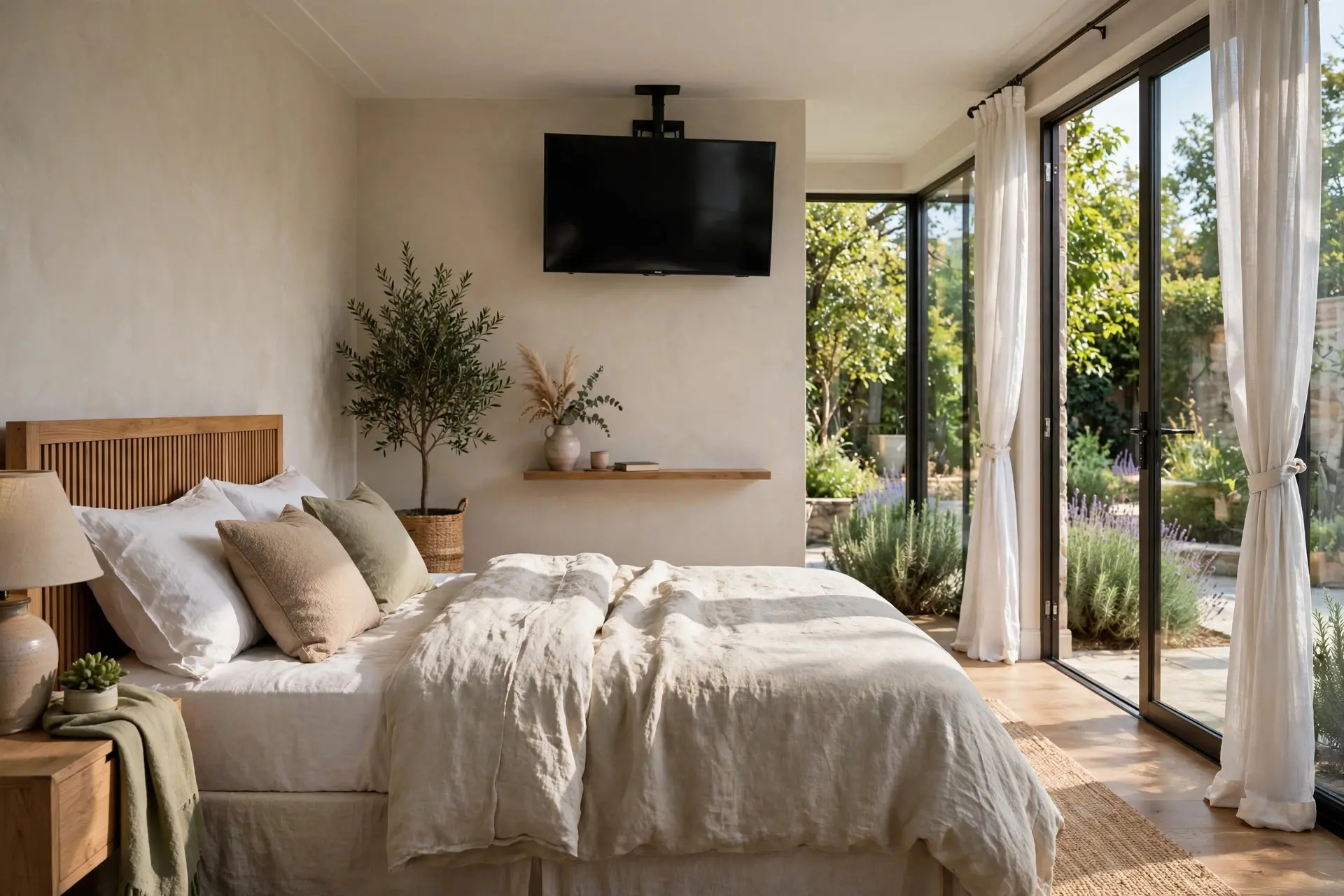
Bedroom viewing is the one case where a high TV is right. You are propped against a headboard, reclined maybe 20 degrees, so your natural sightline is well above horizontal. A screen center around 55 to 60 inches from the floor is normal, and a tilting mount angled down 10 to 15 degrees keeps the picture square to your face.
Measure it the same way as before. Sit up in bed the way you watch, and have someone find your eye height. Bed heights vary far more than sofa heights, so the guess is less reliable here than anywhere else in the house.
Do These Three Things Before You Drill

Order matters more than people expect, and every one of these is painful to fix afterwards.
- Sort the power and cables first. A recessed outlet box behind the screen lets the TV sit flat to the wall instead of being held off by a plug. If you want cables hidden inside the wall, the conduit goes in before the bracket, not after.
- Find the studs and plan the bracket around them. A large TV needs lag bolts into framing, and framing is typically at 16 inch centers. If your ideal horizontal position falls between studs, you need a mount with a wide wall plate that spans two, or a horizontal blocking board fixed across them.
- Mock it up. Cardboard, painter’s tape, two evenings. This single step prevents most regret.
Mistakes Worth Avoiding
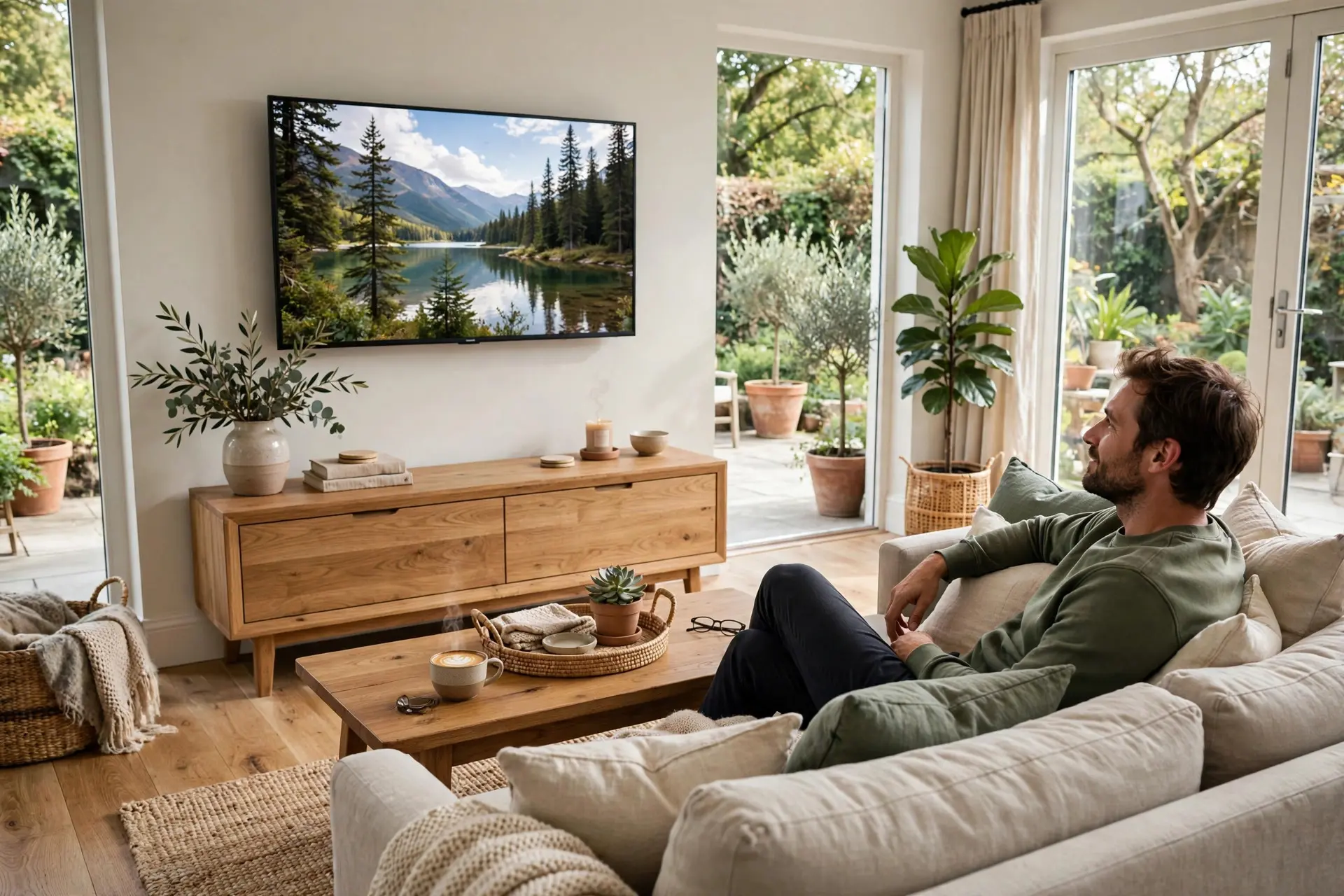
- Centering the TV on the wall instead of on the seating. If the sofa is off center, the TV should be too. Your eyes do not care where the wall ends.
- Matching the height to a neighbour’s installation. Their sofa is not your sofa.
- Mounting before the furniture arrives. Seat height is the input to the whole calculation.
- Forgetting the rug. A thick rug and pad can raise a sofa nearly an inch, which is small but real. Our guide to living room rug ideas covers sizing if that layer is still undecided.
- Ignoring glare. A screen placed opposite a window may need to shift a few inches either way, and that is a better compromise than a perfect height you cannot see in daylight.
Frequently Asked Questions
How high should a 65 inch TV be mounted?
Aim for the center of the screen at your seated eye height, which for most living rooms puts it roughly 39 to 47 inches from the floor. With a screen height near 32 inches, a center at 41 inches leaves the bottom edge about 25 inches off the floor. Measure your own eye height rather than taking the midpoint.
Does TV mounting height change with screen size?
Barely. The center of the screen goes at eye level regardless of size, so the center height stays about the same. What changes is how far the top and bottom edges extend from that point, which affects whether the TV clears your console and fits under a mantel.
Is it bad to mount a TV above a fireplace?
It is bad for viewing comfort, yes. A mantel typically forces the screen center 25 to 30 inches above eye level, which means sustained neck extension. A pull down mount solves it properly, a tilting mount improves the picture but not your posture, and heat rising from a working fireplace is a separate concern worth checking against the TV manufacturer’s stated operating temperature.
How far should the sofa be from the TV?
One and a half to two and a half times the screen diagonal is a reliable working range for mixed content. That is about 7 to 11 feet for a 55 inch screen and 8 to 13 feet for a 65 inch. Closer favours immersion in films, further favours everyday viewing and older broadcast content.
Should the TV be higher if I have a sectional or recliner?
Usually lower, not higher. Deep sectionals and reclining seats drop your hips and often your eye height too. If you recline significantly, your sightline tips upward and you may want the screen a few inches higher plus a slight downward tilt. Measure in your reclined position, since that is how you will watch.
The Short Version
Sit down. Measure to your eyes. Put the center of the screen there. Everything else, from bracket math to tilt angles, is just protecting that one decision. A TV at the right height disappears into the evening, and a TV six inches too high reminds you about it every single time.