Bedside Lamp Height: How Tall a Nightstand Lamp Should Be

You can buy a beautiful lamp, put it on a beautiful nightstand, and still end up squinting at a glowing bulb every time you try to read in bed. That is a bedside lamp height problem, not a taste problem, and it is one of the easiest things in a bedroom to get right once you know what you are aiming for.
Most advice hands you a range and leaves it there. Twenty four to thirty inches tall, good luck. That range is not wrong, but it only works if your bed, your mattress and your nightstand happen to be average. Here is the rule behind the range, plus a two minute measurement that gives you the right number for your actual bed.
The Rule: Shade Bottom at Eye Level
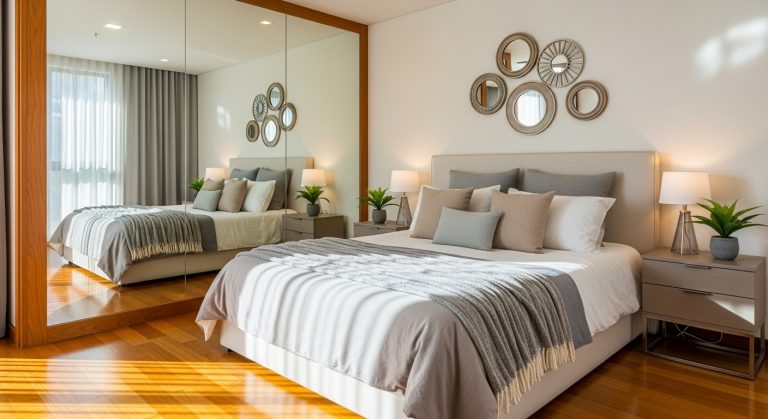
Sit up in bed the way you sit when you read. Now look straight ahead. The bottom edge of the lamp shade should land at roughly that eye level, or an inch or two below it.
That one position does three jobs at once. The shade blocks your direct view of the bulb, so no glare. The light spills downward onto the page or the book in your lap, where you need it. And the top of the shade still throws light up onto the wall, which keeps the corner of the room from going black and makes the whole space feel softer.
Set the shade bottom too high and you look straight into the bulb. Set it too low and the light pools on the nightstand instead of on your book, and the room feels oddly dim even with the lamp on. Everything else about choosing a bedside lamp is secondary to this.
Get Your Own Number in Two Minutes
You need three measurements and one subtraction. A tape measure and somebody to hold it makes this faster, but you can manage alone.
- Your eye height, sitting in bed. Sit up against the headboard or your pillows in your normal reading position. Measure from the floor to the outer corner of your eye. On a typical bed this lands somewhere between 42 and 48 inches, but a tall platform bed with a thick mattress can push it past 50.
- Your nightstand height. Floor to the top surface. Most fall between 24 and 28 inches.
- The shade height of the lamp you are considering. Top of the shade to the bottom of the shade. Usually 9 to 12 inches on a bedside scale lamp, and it is listed on most product pages.
Then the formula:
Lamp height = eye height minus nightstand height plus shade height
Worked example. Eye height 44 inches, nightstand 26 inches, shade 10 inches. That gives 44 minus 26 plus 10, so a 28 inch lamp. Buy a 28 inch lamp and the shade bottom will sit right about at eye level.
Second example, same person on a low platform bed. Eye height drops to 40 inches and the nightstand is a short 22 inch piece. That gives 40 minus 22 plus 10, so a 28 inch lamp again. Which is a useful reminder that low beds usually come with low nightstands, and the two changes cancel out. The cases that go wrong are the mismatched ones.
Third example, the mismatch. A tall bed with a deep mattress puts eye height at 50 inches, but the nightstand is a slim 24 inch table. 50 minus 24 plus 10 gives a 36 inch lamp, which is taller than most bedside lamps are made. That is your signal to fix the nightstand rather than hunt for a giant lamp, and a nightstand height guide will get you to the right table faster than scrolling through lamps will.
Why the Standard Range Exists
Run the formula with average numbers and you land in the 24 to 30 inch band that every lamp guide quotes. That is where the range comes from. It is an average, which makes it a good starting filter when you are shopping and a bad final answer when your bed is unusual.
Two situations push you outside it. Very tall beds with thick mattresses and toppers raise your eye height well above average, and short nightstands lower the starting point. Either one alone is manageable. Both at once means a table lamp is probably the wrong tool, and the next section covers what to use instead.
Three Times a Table Lamp Is Not the Answer
The Nightstand Is Too Small to Share
A lamp should occupy no more than about a third of the nightstand surface. On a 14 inch deep table, a lamp with a 16 inch shade overhangs the front edge, which means you will catch it with an elbow eventually. If the lamp that fits your height needs a shade wider than the table, go to the wall instead.
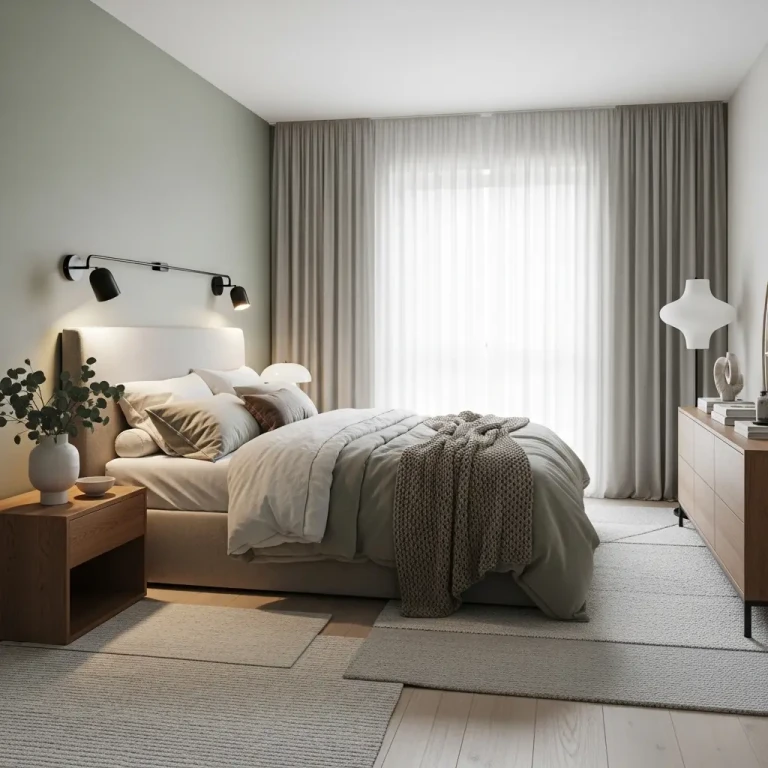
A plug in swing arm sconce solves the height and the footprint in one move. Mount the arm so the shade sits at the same eye level target, which usually means roughly 24 to 30 inches above the top of the mattress, and keep it far enough from the pillow that you can reach the switch without sitting up. The nightstand then holds a glass of water and a book instead of a lamp.
The Headboard Changes the Geometry
A tall upholstered headboard sits you further forward, which shifts your eye position relative to the nightstand. A very low headboard or no headboard at all does the opposite. Measure in the position you actually read, with your pillows where they really end up, not with the bed styled for a photo. If you are still planning the bed, the headboard height you choose is worth settling before the lamps.
Two People, Two Habits
One reads until midnight, the other wants the room dark. Matching table lamps make that a negotiation every night. A directional reading sconce with a tight beam on one side, or a clip on book light, solves it better than any amount of lamp shopping. Symmetry is nice. Sleep is nicer.
Shade Width and Proportion
Height sets the function. Width sets whether it looks right.
- Shade diameter should be roughly 60 to 70 percent of the total lamp height. A 28 inch lamp wants a shade somewhere around 17 to 19 inches at its widest point. Narrower starts to look spindly, wider looks top heavy.
- The shade must not overhang the front edge of the nightstand. Check this with a tape before ordering. It is the most common return reason for bedside lamps.
- The shade should fully hide the bulb and the harp from a seated view. If you can see hardware when sitting in bed, the shade is too short or too narrow.
- Linen and fabric shades spread light softly. Opaque shades, metal or dark card, throw light straight down and up in two tight cones. Opaque is better for focused reading and worse for ambient glow, so pick based on which you actually want at 10pm.
The Bulb Matters More Than the Lamp
A perfectly positioned lamp with the wrong bulb still ruins the room.
- Go warm. 2700K or lower. Some bulbs sold as warm dim drop toward 2200K as they dim, which is closer to candlelight and very pleasant at bedtime.
- Do not overbuy brightness. Something in the range of 400 to 800 lumens is plenty for reading at arm’s length. A 1500 lumen bulb in a bedside lamp is a floodlight.
- Make it dimmable, and check the lamp supports it. A bedside lamp with one brightness setting is a bedside lamp you stop using.
- A three way socket is the cheapest version of dimming and works with no smart anything, which matters if the lamp is for a guest room.
One practical detail worth sorting at the same time. If your nightstands have no outlet behind them, decide now whether the cord runs along the floor or the lamp becomes a wall mount. Discovering this after the lamps arrive is a small but genuinely annoying way to end a project.
Do the Lamps Have to Match?
No, but they should agree on two things: shade bottom height and shade color. Those are what your eye compares across a bed. Two different bases at the same height with the same shade tone read as intentional. Two matching bases at different heights read as a mistake, even when nobody can say why.
This also gives you a way out of the common problem where one side of the bed is against a wall and the other is open. Use a table lamp on the open side and a sconce on the wall side, set both shade bottoms to the same height, and the asymmetry stops being noticeable. While you are measuring, it is worth confirming the bed itself leaves proper walking clearance on both sides, which a bed size guide covers room by room.
Frequently Asked Questions
How tall should a bedside lamp be?
Most bedside lamps land between 24 and 30 inches tall, and for an average bed and nightstand that works. For your specific bed, take your eye height sitting up, subtract your nightstand height, then add the shade height. That number is the lamp height that puts the shade bottom at eye level.
Should the lamp be taller than the headboard?
It does not need to be, and on a tall headboard it should not be. The shade bottom at eye level is the target. Where the lamp sits relative to the headboard is a styling question, and a lamp whose shade top lines up somewhere around the middle of the headboard usually looks balanced.
How high should a wall sconce be above the bed?
Aim for the shade or diffuser bottom to land at your seated eye level, which usually puts a fixed sconce somewhere around 24 to 30 inches above the top of the mattress. Swing arm models give you adjustment, so mount them within that band and fine tune by moving the arm.
What if my nightstand is much shorter than my mattress top?
Then no normal lamp will reach eye level, because you are starting too low. Replace the nightstand with a taller one, or switch that side to a wall mounted sconce. Stacking books under the lamp works for a week and looks like it for a year.
Can one bedside lamp light a whole bedroom?
Not well. A bedside lamp is a task light that happens to add some ambient glow. A bedroom reads best with at least two or three light sources at different heights, so pair the lamps with an overhead on a dimmer or a floor lamp in a far corner.
The Short Version
Sit up in bed, measure to your eye, subtract the nightstand, add the shade. Buy that height. Keep the shade narrower than the nightstand, use a warm dimmable bulb around 400 to 800 lumens, and match shade bottom heights rather than lamp bases. Two minutes with a tape measure is the difference between a lamp you read by every night and a lamp you keep meaning to replace.