

You can spend a fortune on cabinets and still end up with a kitchen that looks slightly off. Usually the culprit is small, literally. Undersized pulls on wide drawers make an expensive kitchen read like flat pack, and no amount of quartz fixes it.
Kitchen cabinet hardware is one of the cheapest things in the room to change and one of the easiest to get wrong, because most people pick a handle they like and buy the same one for everything. The pieces that look right are sized in proportion to what they sit on, and placed to a repeatable set of measurements.
Here is the sizing rule, the placement numbers, and how to test all of it before a single hole gets drilled.
The One Third Rule Does Most of the Work

The standard guideline designers use is that a pull should be roughly one third the length of the door or drawer front it sits on. On a door, measure the height. On a drawer, measure the width.
The rule works because it keeps the handle visually tied to its cabinet. A 4 inch pull on a 36 inch drawer looks like a mistake, and a 12 inch pull on a 15 inch drawer looks like a gym bar. One third lands in between and reads as deliberate at almost any scale.
Applied to common drawer widths, you get something close to this:
- 12 to 15 inch drawer: a 3 to 4 inch pull, or a knob.
- 18 inch drawer: a 5 to 6 inch pull.
- 24 inch drawer: a 7 to 8 inch pull.
- 30 inch drawer: a 10 to 12 inch pull, or two smaller pulls.
- 36 inch drawer and wider: two pulls, or one long appliance style pull.
For doors, most base and wall cabinet doors take a 4 to 6 inch pull. Tall pantry doors, which can run 80 inches or more, look best with something in the 12 to 18 inch range. That is where the one third rule breaks down and common sense takes over, because a 26 inch handle on a pantry door is a ladder rung.
When you are between two sizes, go up. Slightly oversized hardware reads confident. Slightly undersized hardware reads cheap.
Center to Center Is the Number You Order By

This trips up almost everyone the first time. Pulls are sold by two different measurements and they are not the same.
- Center to center is the distance between the two screw holes. This is the number that must match your drill holes. It is often written in millimeters, so 96mm, 128mm and 160mm are common.
- Overall length is the full length of the handle including the ends. This is the number you use for the one third rule.
A pull described as 5 inches usually has a 5 inch center to center and an overall length closer to 5.75 inches. If you are replacing existing hardware without drilling new holes, center to center is the only number that matters, and you are limited to whatever matches. Measure your existing screw spacing before shopping, not after.
Knobs or Pulls, and Where Each One Belongs
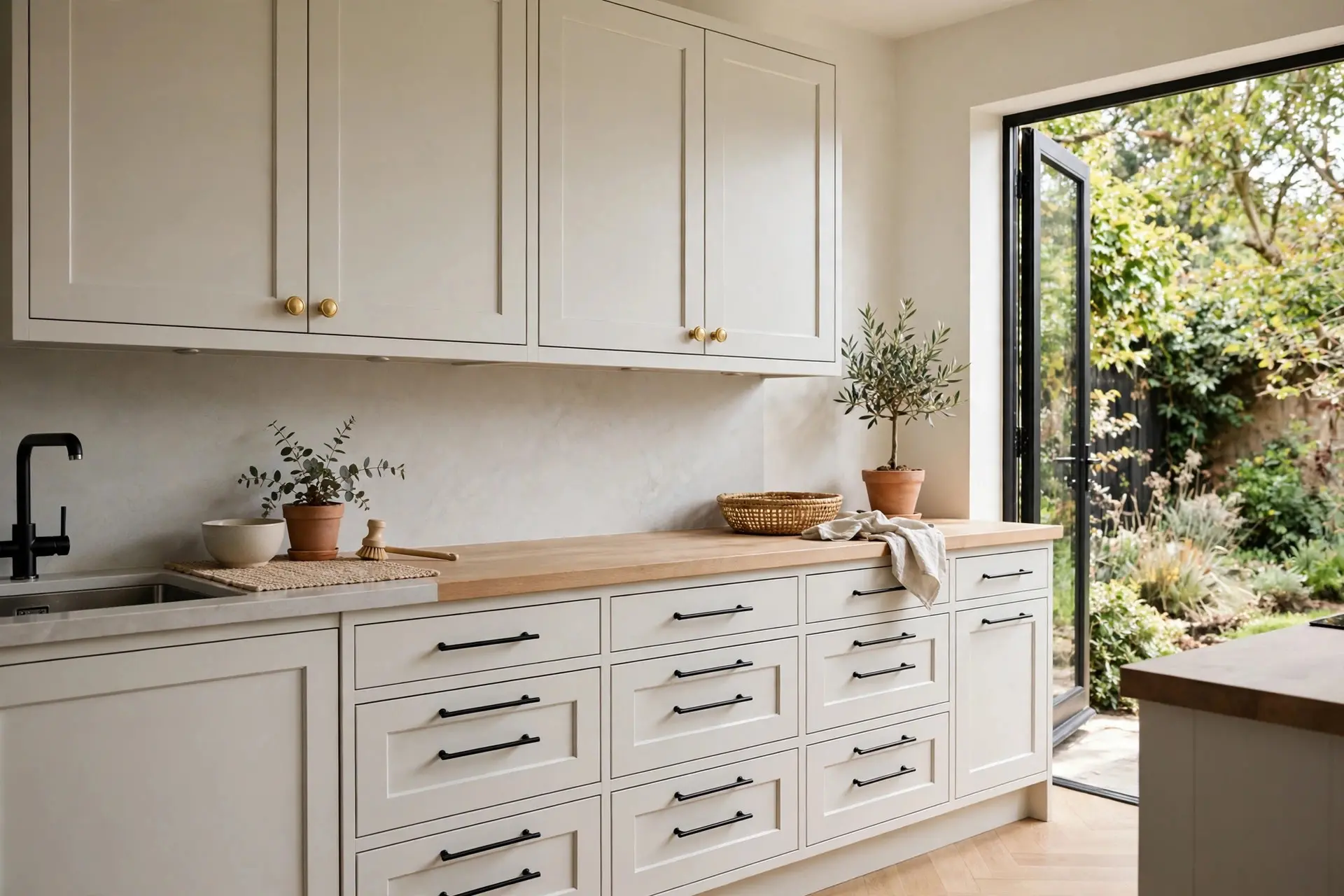
There is no rule that says you must pick one. The most common professional approach is knobs on doors and pulls on drawers, which gives visual variety while keeping the logic obvious to anyone using the kitchen.
A few practical points that usually decide it:
- Heavy drawers full of pots want a pull. A knob concentrates all the force on one point and on your fingertips.
- Anyone with limited grip strength or arthritis will find pulls far easier, because you can hook a whole hand through them.
- Knobs cost less and install with one hole, so a knobs on doors approach saves both money and drilling time across a large kitchen.
- In a narrow galley, protruding pulls on base cabinets catch pockets and tea towels. Low profile pulls or knobs make more sense.
Exact Placement, Measured From the Corner
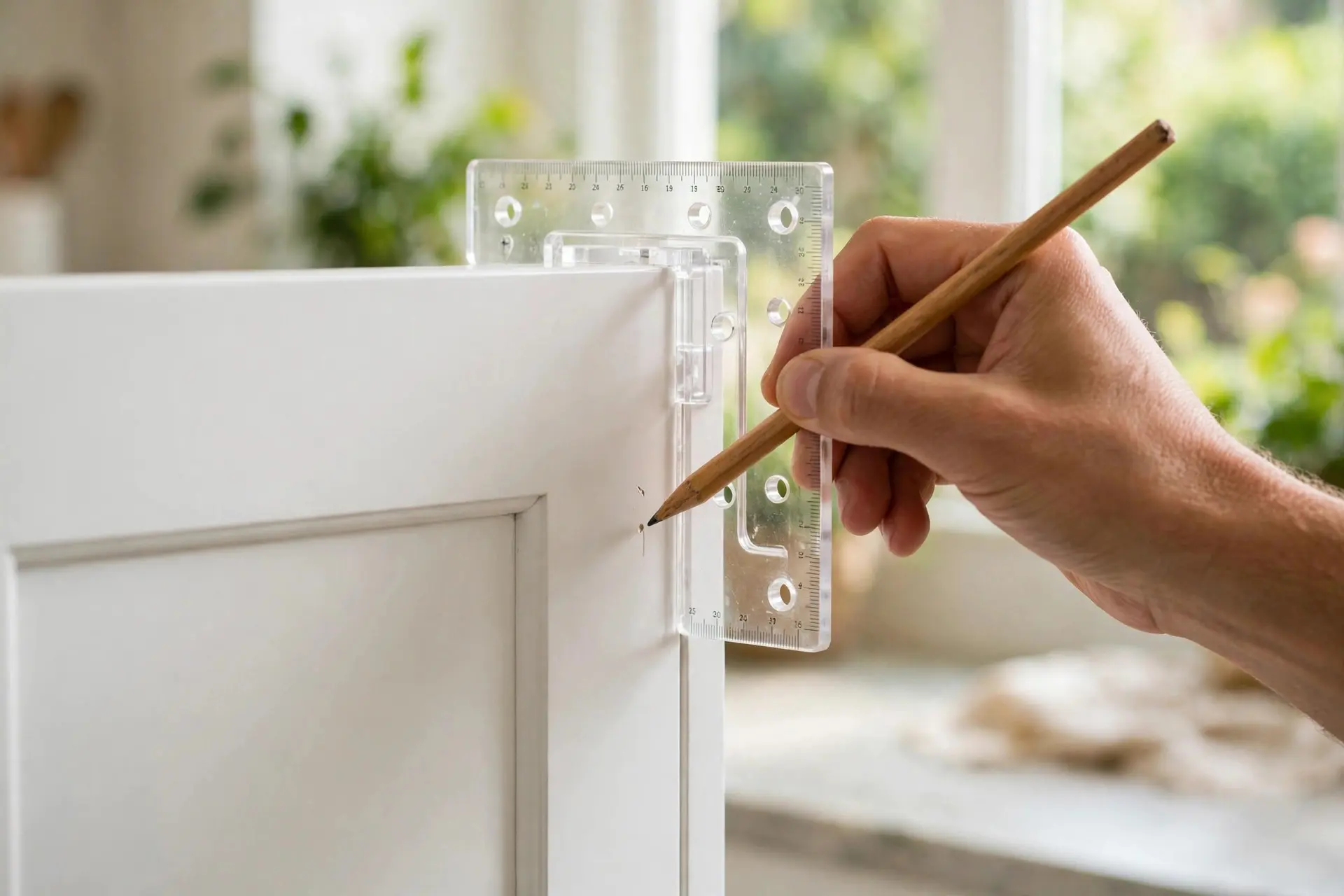
Placement is where kitchens start looking custom or start looking rushed. These are the conventional positions, and they work because they keep every handle in the same visual zone at eye level and at hand level.
Knobs on doors
Place the knob 2.5 to 3 inches in from the edge of the door, measured diagonally from the corner. On a wall cabinet, that is the bottom corner nearest the opening side. On a base cabinet, it is the top corner. On a shaker style door, a clean approach is to center the knob in the corner of the flat stile rather than eyeballing it, which keeps every knob identical without a tape measure.
Pulls on doors
Mount vertically, 2.5 to 3 inches in from the opening edge. On wall cabinets, align the bottom of the pull about 3 inches up from the bottom of the door. On base cabinets, align the top of the pull about 3 inches down from the top. Keep the same offset across the whole run and the eye reads a straight line even though the cabinets are different sizes.
Pulls on drawers
Center horizontally, always. Vertically, center the pull on drawer fronts up to about 8 inches tall. On taller drawer fronts, such as the deep bottom drawer of a pot bank, moving the pull up so it sits 2.5 to 3 inches below the top edge usually looks better and is easier to use, because that is the natural height your hand reaches for.
Wide drawers
Once a drawer passes about 30 inches wide, one pull in the middle lets the front flex and twist as it opens. Two pulls, each centered over its own drawer slide roughly a quarter of the way in from each end, opens more smoothly and looks more considered. The alternative is a single long appliance pull that spans most of the front.
Mixing Finishes Without Making a Mess
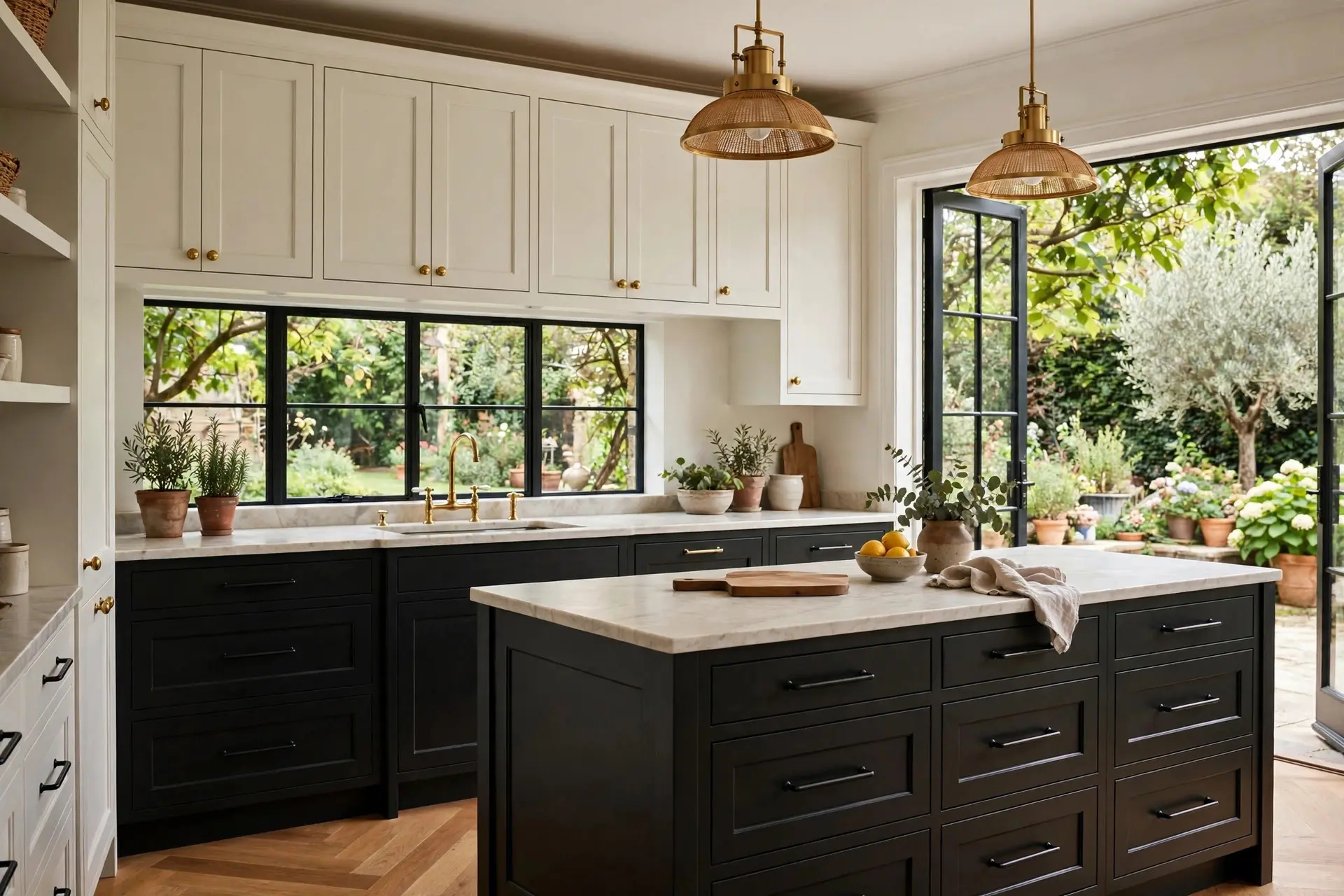
Mixed metals work, but only with a structure behind the choice. The approach that consistently looks intentional is to pick one dominant finish for about 70 percent of the metal in the room and one accent for the rest.
A common and reliable split is matte black or brushed nickel on the cabinet hardware, with brass on the tap and the light fittings. What rarely works is three finishes at equal weight, because nothing reads as the anchor.
Two things worth knowing before you commit:
- Unlacquered brass will darken and develop a patina with use. Some people love that and some are surprised by it. Lacquered brass holds its color but can wear unevenly at the handles you touch most.
- Matte black shows fingerprints and water spots much less than polished chrome, but it also shows dust and scratches more. In a kitchen with small children, a brushed finish is the forgiving middle ground.
Hardware finish also has to sit comfortably against the cabinet color. Dark cabinets are less forgiving than pale ones, which is worth thinking about early if you are planning black kitchen cabinets, and the same goes for how the metal reads against your backsplash choice.
Test It Before You Drill

Every hole you drill in a cabinet front is permanent. Two cheap tests save a lot of regret.
The first is the paper test. Print or cut paper rectangles the size of the pulls you are considering, tape them on the actual cabinets, and look at them for a day. Scale is impossible to judge from a product photo and obvious from six feet away in your own kitchen.
The second is the sample order. Buy one of each finalist, install them on one door and one drawer, and live with them for a week. Handles are the part of a kitchen you physically touch a hundred times a day, and the difference between a pull that feels good in the hand and one that feels thin is not visible in any photograph.
When you do drill, use a hardware jig. It is an inexpensive tool that guarantees every hole sits at the same offset, and it turns a nerve wracking job into a repetitive one. Drill from the front face with a backer block clamped behind to stop the wood blowing out on the exit side.
Count Before You Cost It
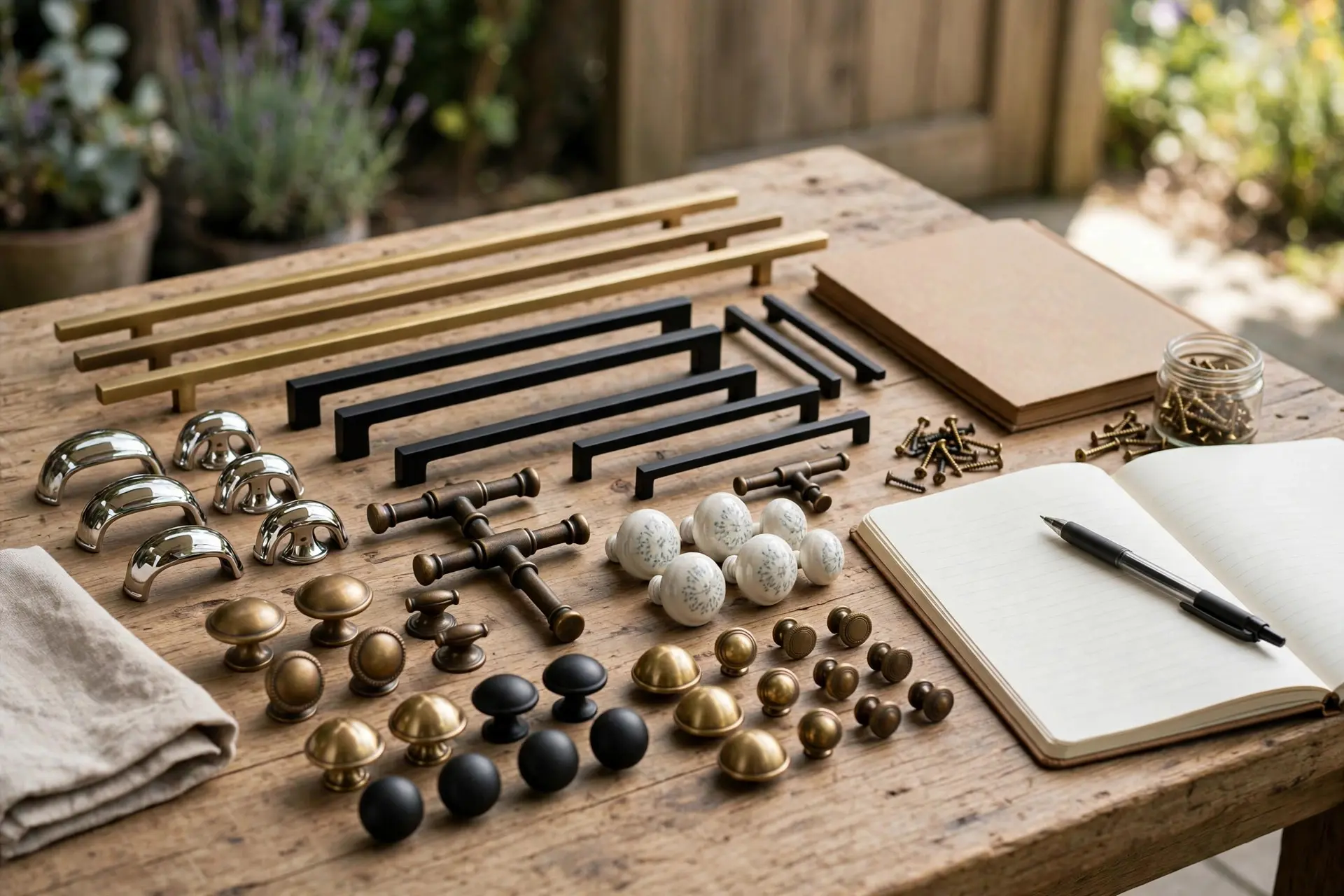
Hardware feels cheap per piece and adds up fast. A modest kitchen with 10 wall doors, 8 base doors and 12 drawers needs 30 pieces. At a comfortable price per handle that is a real line in the budget, and premium solid brass pulls can cost several times that.
Two ways to spend well. Put the money into the drawers, since those are the pieces you touch most and see most, and use simpler knobs on doors. Or choose one good looking mid price handle and buy it in a single order, because dye lots and finishes drift between production runs and a reorder six months later may not match.
Always order two or three spares. Screws strip, finishes get damaged during installation, and finding the exact same handle later is often impossible. If you are working through a wider kitchen refresh, it helps to settle the countertop direction and the overall look of the kitchen before locking in a metal finish.
Frequently Asked Questions

What size pulls should I use on kitchen cabinets?
Aim for a pull roughly one third the length of the drawer front or door it sits on. In practice that means 4 to 6 inch pulls on most doors, 5 to 8 inches on standard drawers, and 10 inches or more on drawers wider than 30 inches.
Where exactly do knobs go on cabinet doors?
Place them 2.5 to 3 inches in from the corner nearest the opening edge. That is the bottom corner on wall cabinets and the top corner on base cabinets. On shaker doors, centering the knob in the corner of the flat frame keeps every one consistent.
Should the handles on drawers and doors match?
They should belong to the same family, but they do not have to be identical. Knobs on doors with matching pulls on drawers is the most common approach and it looks deliberate. Mixing two completely different styles across the same run usually does not.
How many pulls does a wide drawer need?
One pull is fine up to about 30 inches. Past that, use two pulls placed about a quarter of the way in from each end, or a single long appliance pull. Two pulls also reduce the twisting that makes a heavy wide drawer stick.
Can I change cabinet hardware without new holes?
Yes, if the new pulls have the same center to center measurement as the old screw holes. Measure between the centers of the existing holes first, then filter by that figure when shopping. If you want a different size, you will need to fill and redrill, which means touching up the finish.
Size by proportion, place from the corner, test on cardboard, and buy a few spares. Kitchen cabinet hardware is a small budget line that quietly decides whether the whole room looks finished.