

There is a moment on the first cool night of the year when someone lights a fire pit and everybody drifts toward it. Then, about ten minutes later, half the group is standing up because the chairs are too far from the heat, or too close, or facing the wrong way. That gap between a fire pit that looks good in photos and one people actually settle into comes down to the seating, not the fire.
So the fire pit seating area ideas below start with the circle around the fire and work outward to layouts, materials, and the small details that make a seating area feel finished instead of assembled.
Get the spacing right before you buy anything

Most fire pit seating problems are spacing problems. Sit too close and the heat becomes uncomfortable within minutes. Sit too far back and you feel like you are watching the fire on television.
A good working range is about five to seven feet from the outer edge of the fire pit to the front edge of your seats. Closer to five feet suits a small propane bowl that throws gentle heat. Closer to seven feet suits a big wood burning pit that puts out real radiant warmth and the occasional spark.
Two more numbers worth keeping in mind:
- Leave roughly 30 to 36 inches of clear walking space behind the seating so people can get in and out without squeezing past knees.
- Plan a total seating area diameter of about 12 to 14 feet for a standard round pit. That sounds large on paper and looks completely normal once the furniture is in place.
Before you commit, mark the circle with a garden hose or a rope and put your existing chairs on it. Sit there for twenty minutes. You will learn more in that twenty minutes than in an hour of scrolling.
Also check two boring but important things: the clearance distance printed in your fire pit’s own instructions, and whether your city or HOA has rules about open flames, fuel type, and distance from structures. These vary a lot by area and they override any design advice.
Seating layouts that change how the space feels


The full circle
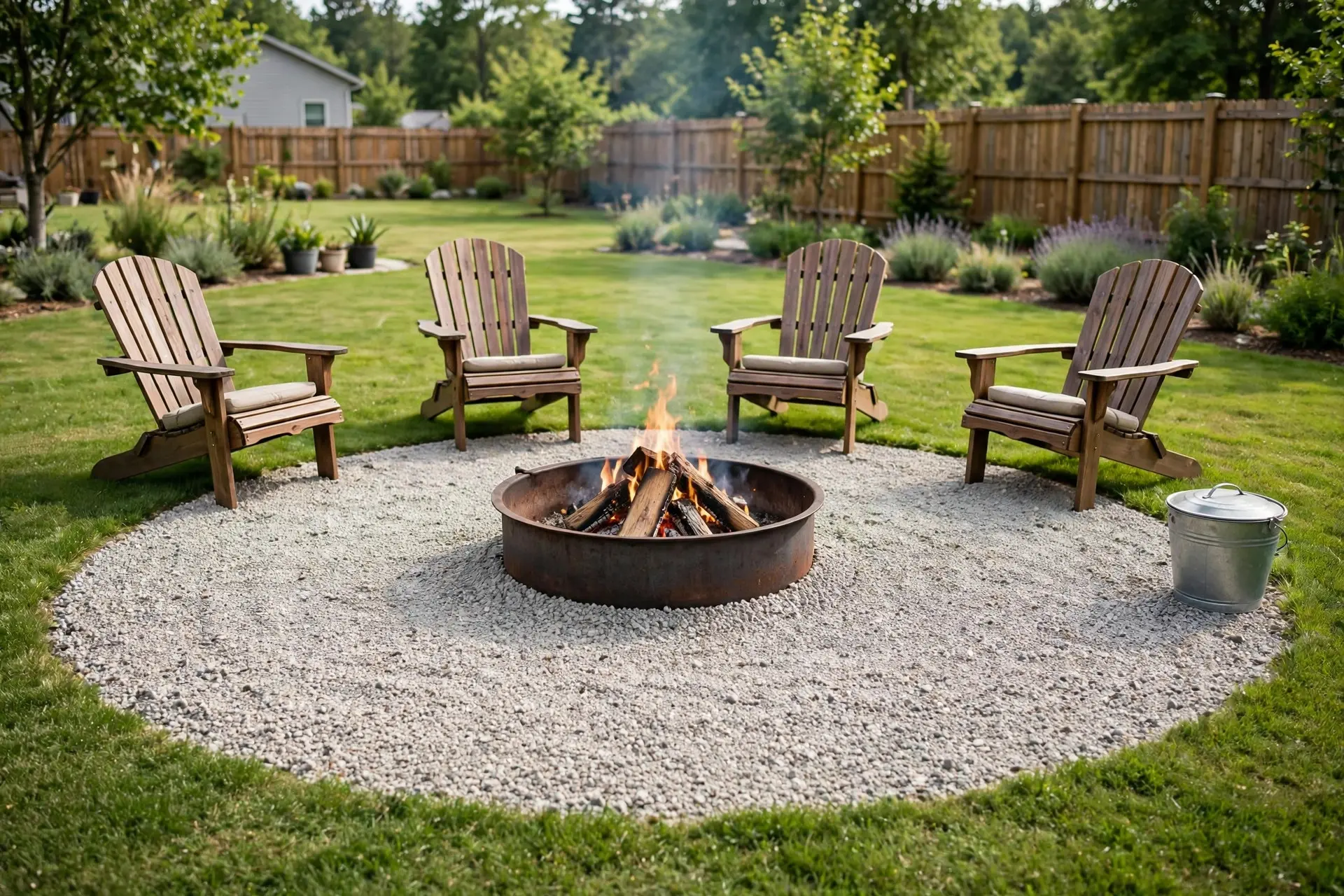
Chairs evenly spaced all the way around. It is the most social layout because everybody can see everybody, and it works beautifully in the middle of a lawn or on a round patio.
The catch is that a full circle needs open space on every side, and it turns its back on whatever view you have. If your yard has a nice tree line or a sunset, this is not the layout for it.
The three quarter circle
Leave one section open. Suddenly the seating faces a direction on purpose, whether that is the view, the house, or the rest of the garden. It also creates a natural entry point so nobody has to step over a chair.
This is the layout I would suggest to most people with a normal sized yard. It keeps the warmth and the conversation of a circle while feeling less like a meeting.
Two facing benches
Simple, tidy, and very good in narrow spaces. Two benches on opposite sides of the pit read as intentional architecture rather than scattered furniture, and benches seat more people per foot than chairs do.
The downside is comfort over a long evening. Backless benches get tiring. If you go this route, plan for cushions and a few floor poufs, or build one of the two benches with a back.
Built-in L shape with movable chairs
A low wall or built-in bench along two sides, then two or three movable chairs to close the loop. This is the most flexible option and often the best looking, because the built-in part anchors the space while the chairs let you adapt to two people or ten.
The sunken lounge
A recessed seating area with the pit at floor level is the version that stops people mid scroll, and it genuinely feels sheltered and cozy. It is also the most expensive and least reversible choice, and it needs serious thought about drainage. A sunken area without a drain becomes a bowl that holds water.
Built-in seating or movable furniture

Built-in seating wins on looks and on capacity. A curved stone or concrete bench hugging the fire pit is the detail that makes a backyard look designed. It seats more bodies, it never blows over in wind, and it does not need storing for winter.
Movable furniture wins on comfort and flexibility. Chairs with backs and arms are simply nicer to sit in for two hours, and you can pull them closer when the temperature drops.
The honest answer for most homes is a mix. Build one curved or straight bench for structure and capacity, then add two or three good chairs. You get the photogenic architecture and the comfortable seats.
One practical note on built-ins: a comfortable seat height is around 18 inches, and a seat depth of about 18 to 20 inches lets an adult sit back without their feet dangling. Anything much shallower turns into a perch.
Materials that hold up outside
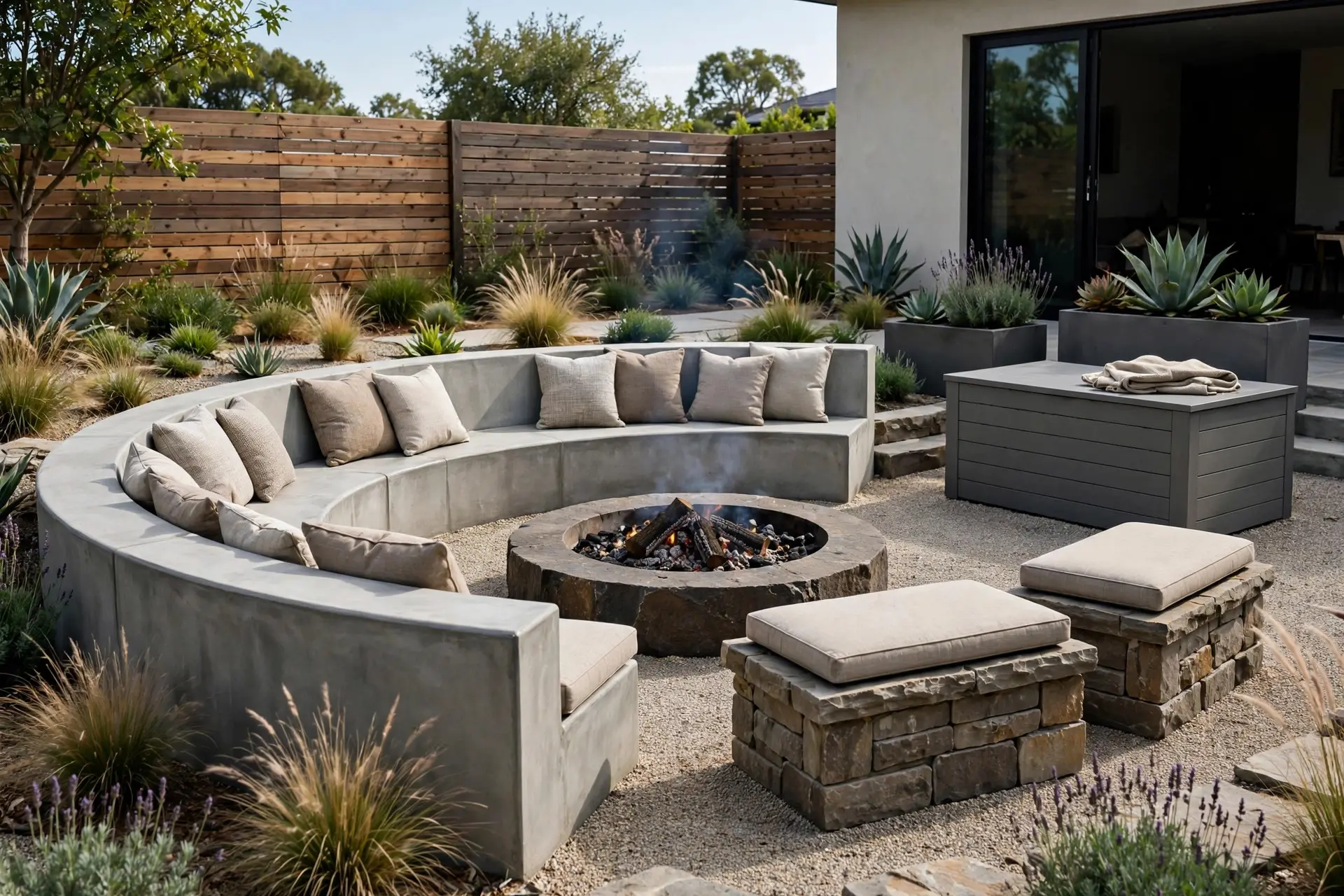
Stone and concrete
The safest choice near fire. Stone benches, concrete block seat walls, and poured concrete all shrug off heat, weather, and sparks. They are cold and hard to sit on, which is what cushions are for.
Wood
Warm, friendly, and the thing most people actually want to touch. Keep it a sensible distance from the flame, choose a species that handles weather in your climate, and accept that wood needs attention every year or two. Wood built directly against a wood burning pit is asking for scorch marks.
Metal
Powder coated steel and aluminum chairs are light, easy to move, and easy to store. Bare steel will rust in a wet climate unless you happen to like the patina.
Cushions and textiles
This is where fire pit areas usually fail. Regular indoor cushions on an outdoor seat last about one season. Look for outdoor rated fabric, and more importantly, give yourself somewhere to put the cushions when it rains. A deck box, or a bench with storage inside, solves this permanently and is the single most useful piece of furniture in the whole setup.
Keep throws and blankets in a basket nearby rather than draped over the seats. They stay dry, and they quietly invite people to stay longer.
Fire pit seating for a small yard
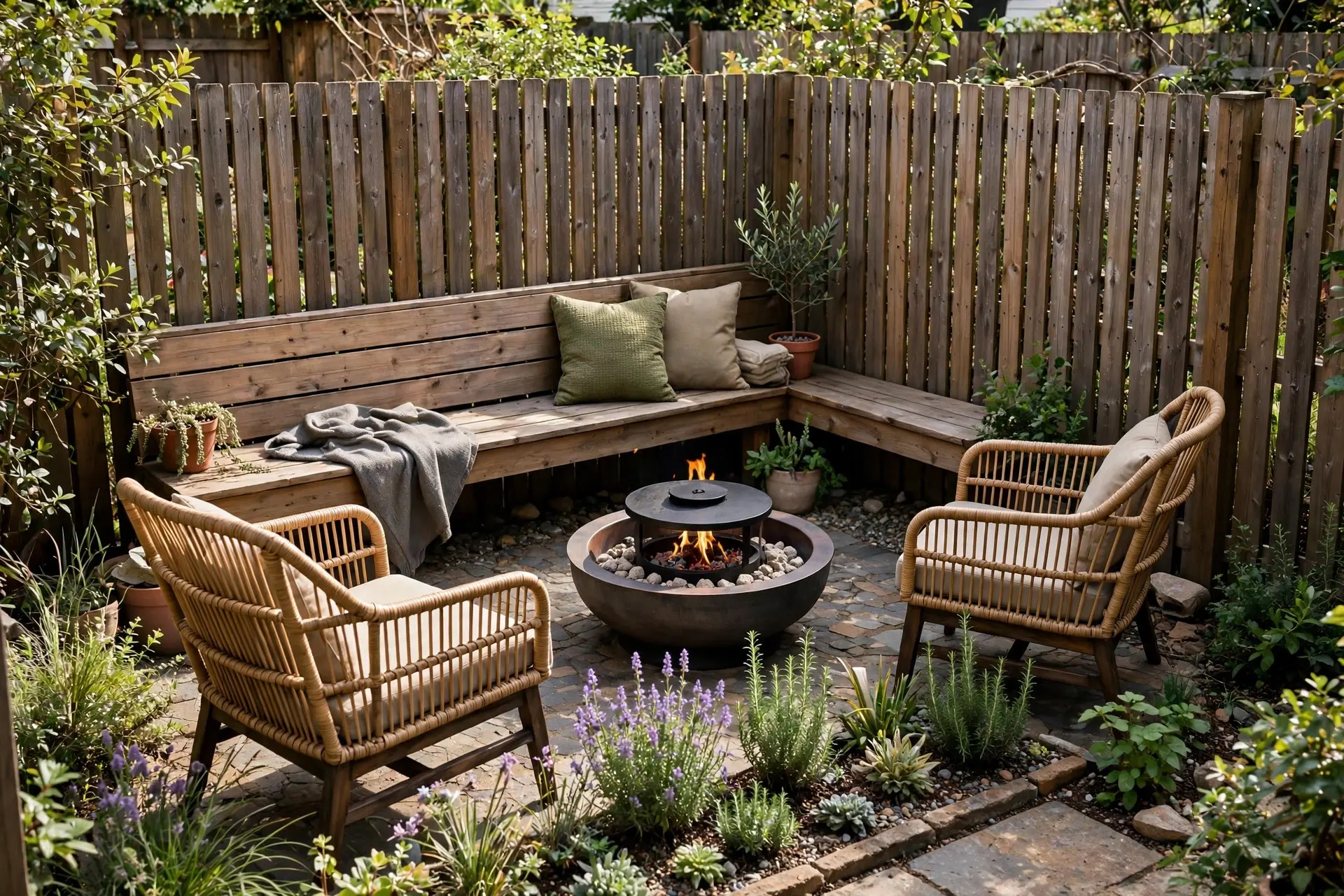
A small space does not rule out a fire pit. It rules out a full circle.
- Push the pit toward a corner and wrap seating around the two open sides.
- Use a smaller pit. A 24 to 30 inch bowl needs far less clearance than a 40 inch one, and it still gives you flame and warmth.
- Choose propane or gas. No wood pile, no ash bucket, no spark distance, and you can sit closer.
- Build seating into boundaries you already have. A bench along a fence or a retaining wall costs you zero floor space.
- Give one side of the circle to a narrow planting bed instead of a chair. It softens the area and stops it looking like furniture crammed into a corner.
If your outdoor space is genuinely tight, our guide to yard landscaping for small spaces covers how to zone a small yard so a fire pit does not swallow the whole thing.
Fuel type quietly decides your layout
Wood burning pits give you the crackle, the smell, and the strongest heat. They also give you smoke that moves with the wind, sparks that need clearance, and firewood that needs storing. Plan wider spacing and skip delicate fabrics.
Propane pits light instantly, make no smoke, and let you sit closer. They need a tank hidden somewhere, which is worth designing for rather than discovering later. A side table with a cabinet, or a built-in enclosure, keeps it out of sight.
Natural gas pits are the most effortless to use and the most involved to install, since they need a gas line run out to the pit. If you are already doing hardscaping work, that is the moment to consider it.
The details that make it feel finished

Lighting matters more than people expect. Fire alone lights faces beautifully and everything else not at all, so people trip on the way back to the door. Low path lights, a few string lights overhead, or uplighting in nearby planting fixes it without killing the mood. Keep it warm and dim. Bright white light ruins a fire pit instantly.
Surfaces matter too. Everyone around a fire pit is holding something. Two or three small side tables, or a low wall wide enough to set a mug on, removes the awkward balancing act.
If you are choosing pieces now, our roundup of outdoor furniture ideas has options that suit both built-in and movable layouts.
Plants finish the edges. Ornamental grasses catch firelight and move in the breeze. Evergreens give the area structure in winter when everything else is bare. Keep anything dry, resinous, or overhanging well away from the flame.
Ground surface is the last piece. Gravel, pavers, and flagstone all work, and all of them beat lawn, which dies under chair legs and turns to mud. Gravel is cheapest and drains well. Pavers feel more finished and are kinder to chair feet. For the wider space around it, the modern patio ideas guide goes deeper on surfaces and zoning.
Mistakes worth avoiding
- Buying furniture before measuring the circle. Almost every cramped fire pit area started here.
- Putting the pit directly under a tree canopy or a pergola beam. Heat rises, and so does the risk.
- Using an outdoor rug too close to the flame. Sparks and synthetic fibers are a bad combination.
- Forgetting somewhere to put ash. A metal bucket with a lid, stored nearby, saves the whole ritual from becoming a chore.
- Making everything permanent too fast. Live with the layout for a season before you pour concrete.
Frequently asked questions
How far should chairs be from a fire pit?
About five to seven feet from the edge of the pit to the front of the seat covers most setups. Go toward the closer end for a small propane pit and the wider end for a large wood burning one. Always check the clearance distance in your own fire pit’s instructions, since designs differ.
What is the best fire pit seating on a budget?
Two simple benches plus a few folding chairs, on a gravel base. Gravel is inexpensive and drains well, benches give you capacity, and you can upgrade the chairs later without redoing anything underneath.
Can you put a fire pit on grass?
You can, but the grass under and around it will suffer, and the area turns muddy quickly. A gravel or paver base under the pit and the seating is a small amount of work that fixes the problem for good.
How many people should a fire pit area seat?
Six is the sweet spot for most homes. It fits a normal sized yard, keeps everyone within conversation distance, and does not demand a huge clearance circle. Plan six comfortable seats and keep two folding chairs in the shed for bigger nights.
Bringing it together
A fire pit seating area works when the spacing is right, the seats are comfortable enough for two hours, and there is somewhere to put a mug. Everything after that is styling.
Mark your circle with a hose this weekend, sit in it, and adjust before you spend anything. Then build outward. For more ways to shape the space around it, our outdoor area ideas guide covers zoning, shade, and privacy.