

Every house has a spot where the day gets dumped. Shoes, backpacks, a coat that never makes it to a hanger, three reusable bags, one glove. In some homes that spot is a proper mudroom. In most homes it is just the floor near the door.
The good news is that a mudroom is not really a room. It is a system, and the system works in a hallway, a closet, or a five foot stretch of blank wall. The mudroom ideas below are organized by how much space you actually have, because that is the only question that matters before you start.
First, count what comes through the door
Before looking at a single photo, do this. Stand at your entry and count what genuinely arrives there every day.
How many people. How many pairs of shoes per person get worn in a week, not owned. Whether there are backpacks, sports gear, a dog leash, a stroller, work boots. Whether anyone needs somewhere to sit to take shoes off.
This is the step almost everyone skips, and it is why so many beautiful mudrooms end up with a pile on the floor anyway. A bench with three hooks in a house of five people will fail no matter how good it looks.
The working rule is simple: one hook per person for the coat they wear right now, plus one spare. One open shoe slot per person for today’s shoes, with closed storage for everything else. Anything more than today’s items needs a door in front of it, because open storage that holds a season’s worth of coats always reads as clutter.
Mudroom ideas for a wall, not a room


Most homes fall here. You have a stretch of wall near a door and nothing else.
The classic trio
Hooks, a bench, and baskets underneath. It is popular because it genuinely works, and because it can be done in an afternoon.
Get the heights right and it looks built in rather than bought:
- Bench seat at roughly 17 to 18 inches high, which is normal chair height and comfortable for putting shoes on.
- Adult hooks at about 60 to 66 inches from the floor.
- A second, lower row of hooks at around 40 to 44 inches if there are children, so coats actually get hung instead of dropped.
- A shelf above the hooks at about 72 inches for hats, gloves, and the things you only need in winter.
Vertical boards behind everything
This is the single cheapest trick for making a wall of hooks look architectural instead of accidental. Run beadboard, shiplap, or simple vertical slats behind the hooks and bench, paint it in one colour with the trim, and the whole arrangement reads as one designed piece. It also protects the wall from wet coats and scuffed heels, which is the practical reason it exists.
A shallow cabinet run
If you have 12 to 14 inches of depth, a run of shallow cabinets with a bench in the middle gives you closed storage without eating the hallway. Shoes stored on the diagonal fit in shallower cabinets than you would expect.
Paint the whole nook
Colour-blocking the mudroom zone, walls and built-ins together, in a deeper shade than the rest of the hall makes a small area feel deliberate. Deep green, warm clay, muted navy, and soft black all hide scuffs far better than white.
For more ways to make a narrow entry work, our guide to entryway makeover ideas on a budget covers lighting, mirrors, and small footprint furniture.
Mudroom ideas for a closet

A coat closet near the door is the most underused space in a house. Take the door off, remove the single rod, and you have a mudroom shaped alcove.
- Build a bench across the bottom at seat height, with shoe storage underneath.
- Put hooks on the back wall and both side walls. The side walls are the part people forget, and they roughly double your hook count.
- Add a shelf near the top for bins.
- If you want to keep a door, swap the solid one for a curtain or leave it off and paint the interior a contrasting colour so the alcove looks intentional.
This conversion is reversible, cheap, and usually the single biggest improvement available to anyone in a small home. If you are rethinking storage more broadly while you are at it, our closet design ideas guide has layouts worth borrowing.
Mudroom ideas for a real room
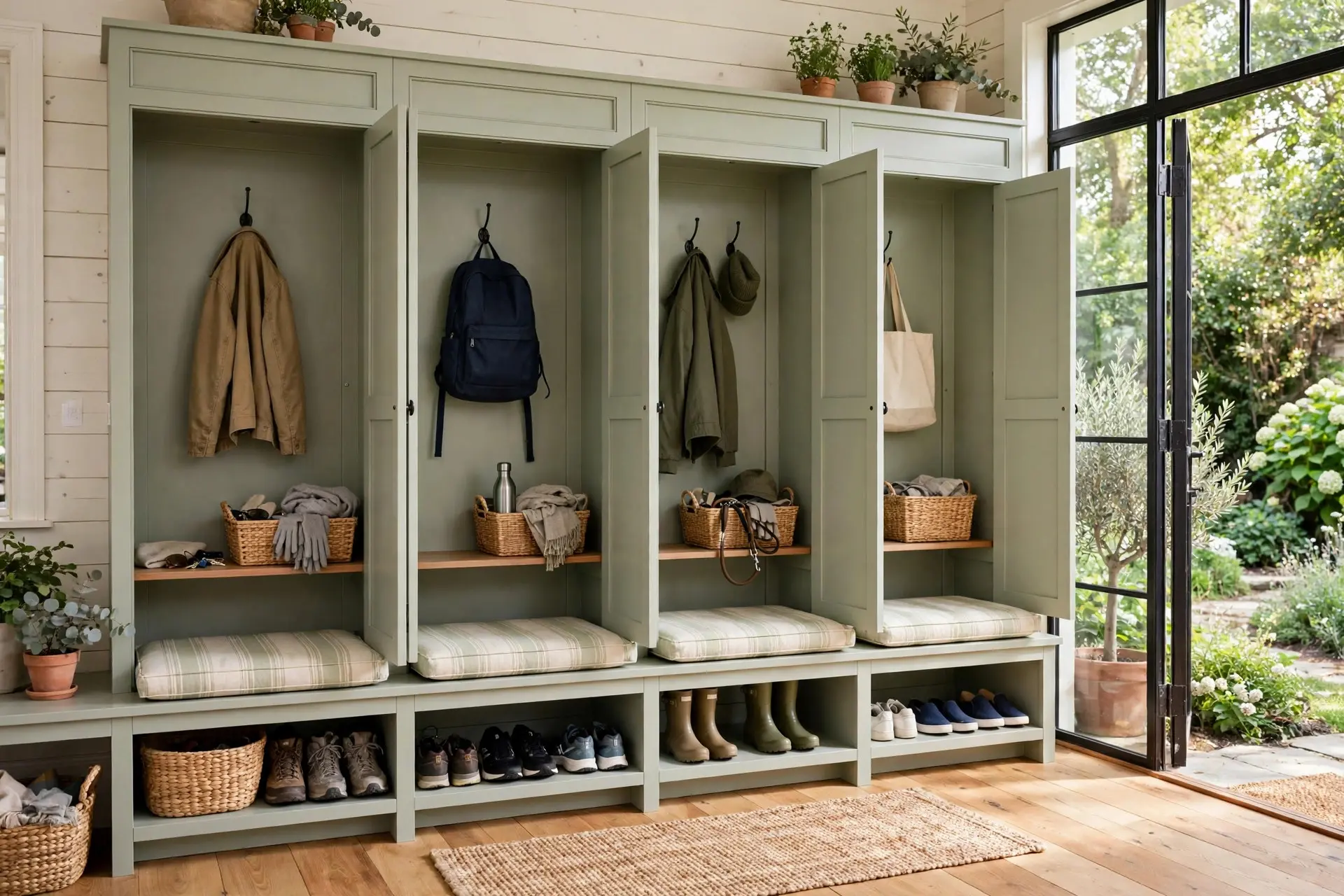
If you have a dedicated space, the temptation is to fill it with lockers. Before you do, think about zones.
Locker style cubbies
One bay per person, with a hook, a shelf, and a shoe cubby inside. They work beautifully for families because ownership is obvious and nobody argues about whose pile is whose.
Make the bays wider than feels necessary. Eighteen inches per bay is comfortable for an adult coat. Fourteen inches looks neat empty and jams the moment a winter jacket goes in.
A drop zone that is not a hook
Keys, mail, sunglasses, and chargers do not belong on hooks or in baskets. They need a small hard surface with a drawer or a tray. A narrow ledge with a bowl on it stops the kitchen counter from becoming the landing pad. Our roundup of key holder storage solutions has ideas that stay tidy without looking like office supplies.
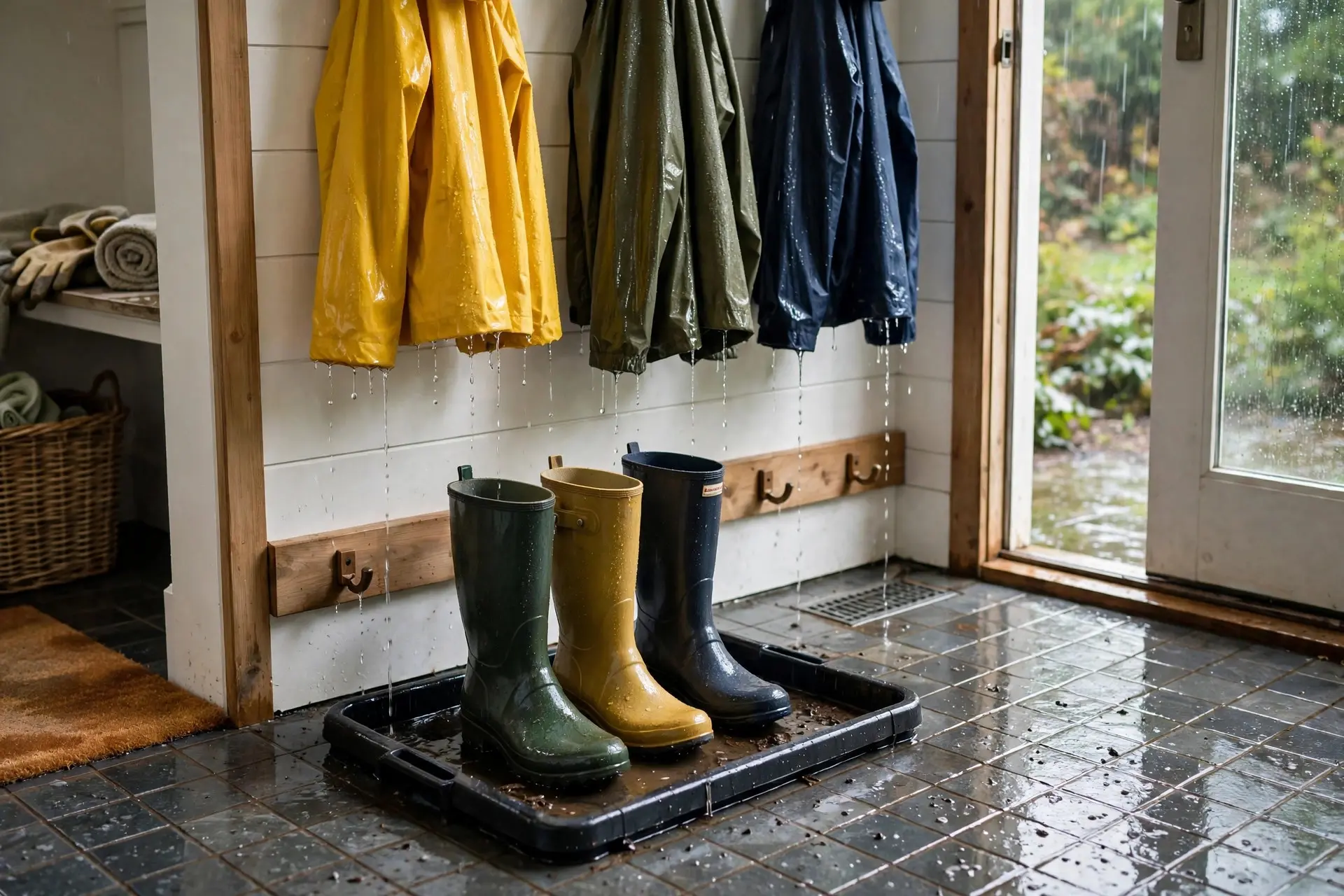
A wet zone
If you get real weather, one section of the room should be allowed to be wet. A boot tray, a tiled or stone floor in that section, and ideally a hook at low height for dripping rain gear. Keeping the wet things in one place is what keeps the rest of the room usable.
Laundry and mudroom together
Combining them is efficient and increasingly common, and it makes sense because both are utility spaces. Just keep the traffic path clear. If someone has to walk around an open washer door to get out of the house, the layout has failed.
Flooring, because this is where mudrooms actually break
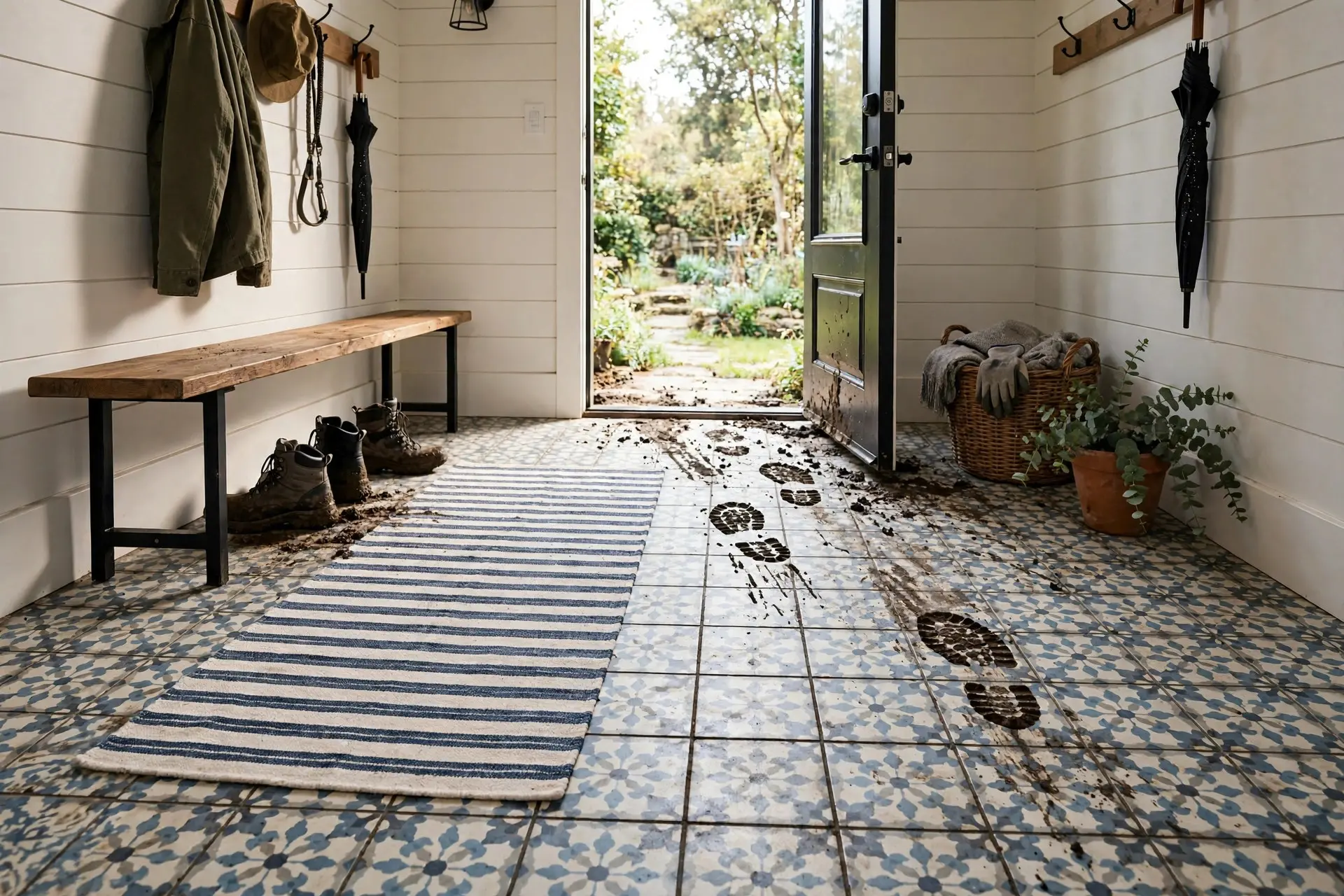
This is the decision with the biggest long term consequence, and the one most guides skip past.
Porcelain tile is the workhorse. It handles water, salt, grit, and dog claws, and it comes in patterns that make a small mudroom look considered. A darker grout is not a design compromise here, it is self defence.
Luxury vinyl plank is warmer underfoot and cheaper, and modern versions handle water well. Check that it is rated for wet areas rather than assuming.
Natural stone looks wonderful and needs sealing, and some stones stain from salt in winter climates.
What to avoid: unsealed hardwood and anything with a soft finish directly at the door. It will show every wet boot print within a season.
Whatever you choose, add a washable runner. Not a decorative rug, a washable runner. The kind that goes in a machine, because it will need to.
Small details that decide whether it stays tidy

- Hooks beat hangers. Every time. People use hooks. Hangers require a decision, and at the end of a long day nobody makes it.
- Open shoe storage beats a closed shoe cabinet for daily shoes. If it takes two actions to put shoes away, they stay on the floor.
- One basket per person, labelled, works better than three shared baskets. Shared baskets become a pit.
- A mirror near the door earns its place. It is the last look before leaving and it bounces light into a usually dark spot.
- A light you can reach with your hands full. A wall sconce on a switch by the door, or a motion sensor, changes how the space feels at 6pm in November.
- Somewhere for the things going out. Library books, returns, the thing you keep meaning to take to a friend. A single designated shelf for outbound items stops them circulating around the house for weeks.
Getting the look without the renovation

Not everything needs building. A convincing mudroom can be assembled from separate pieces if you keep two rules.
First, match the finishes. Same hook metal, same basket material, same wood tone. Mismatched hardware is what makes a DIY setup look improvised.
Second, connect the pieces visually. A painted panel, a single long shelf, or a strip of colour behind everything ties a bench, hooks, and baskets into one unit. Without that connecting element, three good pieces still look like three separate purchases.
If your entry is more about first impressions than muddy boots, our modern entryway and foyer decor ideas guide leans further toward the decorative side.
Frequently asked questions
How much space do you need for a mudroom?
A workable mudroom zone needs about five feet of wall and 14 to 18 inches of depth. That fits a bench, hooks above it, and baskets below, while still leaving a clear walking path. A dedicated room is nice but it is not the threshold for getting the function.
What is the right height for a mudroom bench?
Around 17 to 18 inches, the same as a dining chair. Lower feels awkward to stand up from, and higher leaves feet dangling when you are trying to pull boots on.
Should a mudroom have open or closed storage?
Both, and the split matters. Keep today’s coats and shoes open so they actually get used, and put everything else behind doors or in lidded bins. Open storage holding a whole season of gear is what makes mudrooms look messy even when they are organized.
What flooring is best for a mudroom?
Porcelain tile is the most forgiving choice for water, grit, and salt. Water resistant vinyl plank is a good budget option that feels warmer underfoot. Add a washable runner on top whatever you pick.
How do you make a mudroom look built in on a budget?
Run a panel of beadboard or vertical slats behind the whole zone, paint it and the trim the same colour, then mount your hooks and shelf onto it. That single background element does most of the work of custom cabinetry at a fraction of the cost.
The short version
Count what comes through your door, give every person one hook and one shoe slot they can reach, put everything else behind a door, and choose a floor that can get wet. Then add the panel behind it all so the whole thing looks like it was planned.
That is the entire system. It works on a wall, in a closet, or in a room, and it is the difference between a tidy entry and a pile by the door.