

Autumn is when most people finally plant the tree they have been thinking about all year, and it is also when the most expensive garden mistakes get made. A sapling in a pot looks harmless. Forty years later the same tree is lifting a driveway, filling a gutter every October, and pressing its branches against an upstairs window. Knowing how far to plant trees from a house is the one decision you cannot undo later, because a tree in the wrong place either gets removed or becomes a permanent problem.
The good news is that the guidance is specific and easy to apply. You need two pieces of information: the mature height of the tree and its mature canopy spread. Both are on the nursery tag. Everything below is arithmetic from there.
The Simple Rule, and Where It Falls Short

The most quoted rule is to plant a tree as far from the house as its height at maturity. A 40 foot tree goes 40 feet from the wall.
That rule exists for a specific reason, and it is worth knowing. At that distance, a tree that comes down in a storm falls short of the house. It is a storm safety rule more than a root rule.
It is also impossible to follow on most suburban lots. If you have 25 feet between the house and the property line, you cannot put a 50 foot oak at 50 feet. So the practical approach is to use the mature height rule as your ideal, use the published minimums below as your floor, and choose a smaller species when the floor and the ideal cannot both be met.
Minimum Distances by Mature Tree Size

The Arbor Day Foundation publishes minimums by mature size, and these are the numbers to work from:
- Small trees, mature height 25 feet or less: at least 8 to 10 feet from a wall, or 6 to 8 feet from a corner.
- Medium trees, mature height up to 40 feet: at least 15 feet from a wall, and at least 12 feet from a corner.
- Large trees, mature height over 40 feet: at least 20 feet from a wall, and at least 15 feet from a corner.
The same distances apply to sidewalks and driveways, which is the part people forget. A tree planted a polite distance from the house and 3 feet from the driveway will still crack the driveway.
Notice how much room this actually needs. A red maple or a common oak is a large tree, so it wants 20 feet from the wall as an absolute minimum and more like 50 feet in an ideal world. A dogwood or a serviceberry is happy at 10 feet. On a typical lot, this usually means the honest answer is not where to put the big tree, but which smaller tree to plant instead.
Why Corners Need Less Room Than Walls
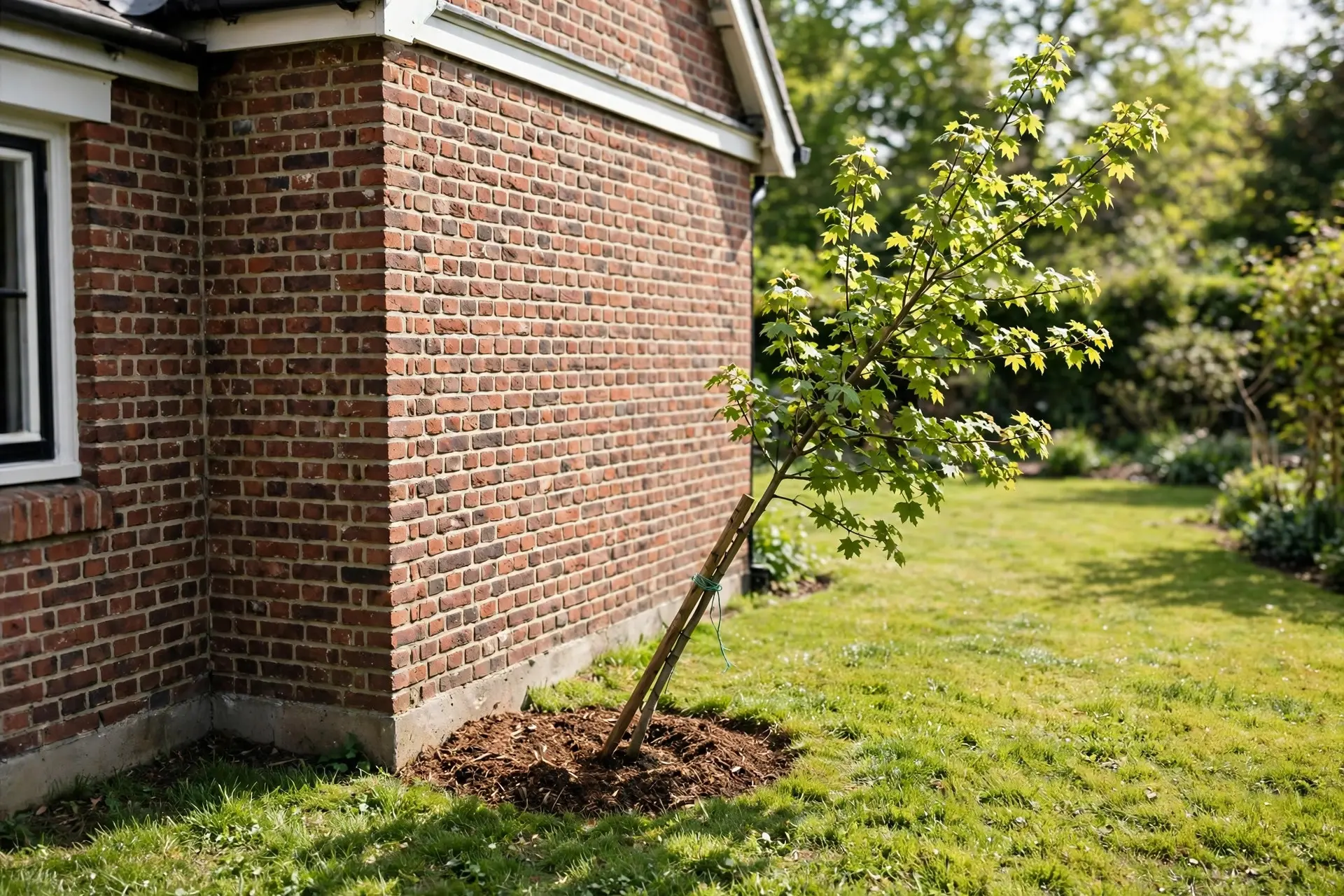
Every set of guidelines allows a tree closer to a corner than to the middle of a wall, and the reason is geometry. At a corner, the canopy can expand into open space in two directions, so the tree is not being forced to grow into the building. Along a wall, the whole side of the canopy runs into brick.
That is useful when you are working with a tight lot. A tree that will not fit 15 feet off the back wall may fit 12 feet off the back corner and grow into a much better shape there.
The Canopy Predicts the Roots

Here is the piece of information most planting guides leave out. Lateral roots generally spread about as wide as the canopy. So the canopy spread on the nursery tag is not just telling you about branches, it is telling you roughly how far the roots will reach.
Use it like this. A tree with a 30 foot mature spread reaches about 15 feet in every direction from the trunk. Plant it 15 feet from the wall and the edge of the root zone arrives at the foundation. Plant it 20 feet out and there is 5 feet of margin.
This is also why a narrow, columnar tree can sit closer to a house than its height alone suggests. A columnar hornbeam or a columnar sweetgum grows tall with a tight canopy, so its root spread stays narrower too. If your problem is a tight side yard, a columnar species solves it in a way that no amount of pruning of a spreading tree will.
Overhead Power Lines
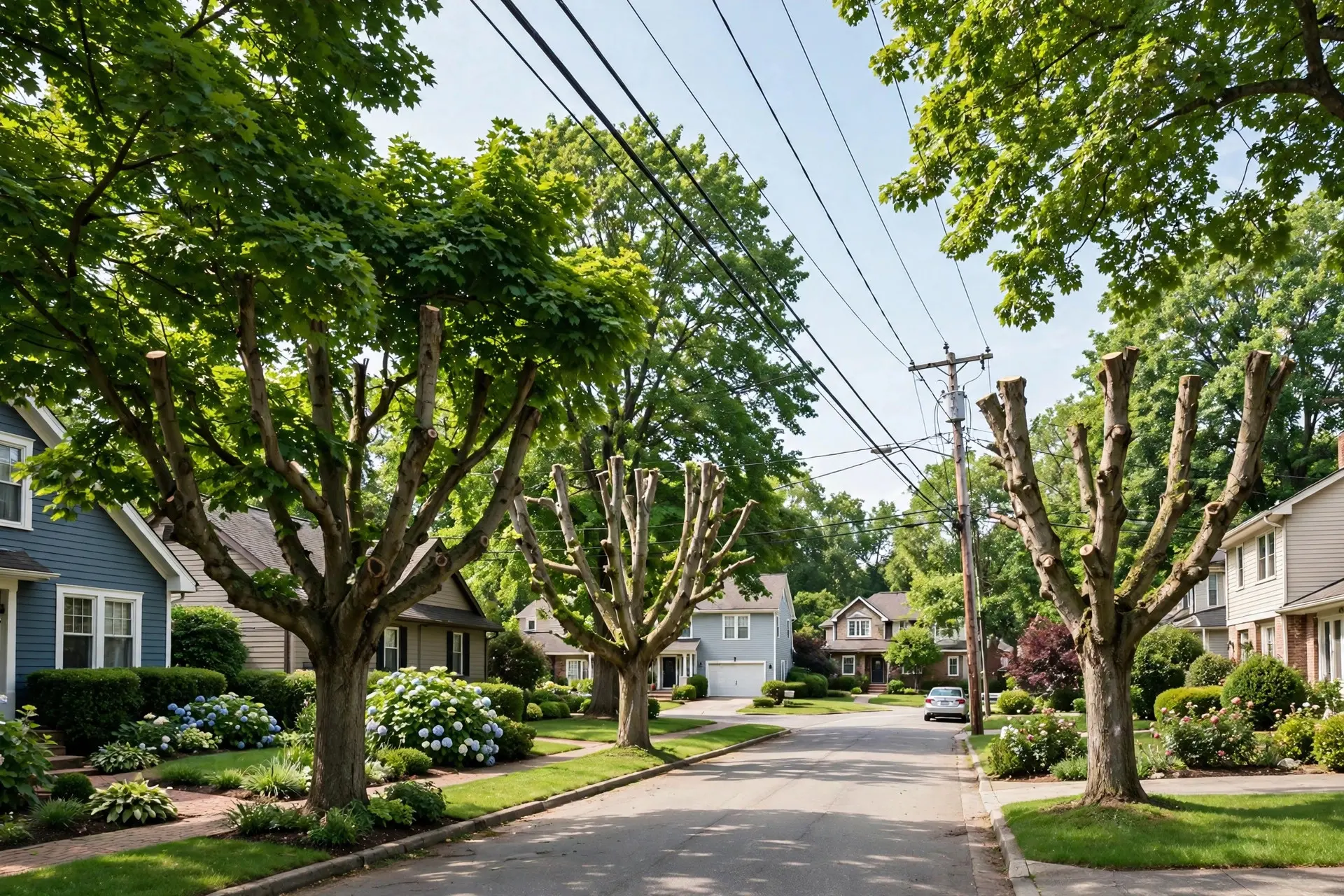
Look up before you dig. Utility crews will eventually cut a tree away from a line, and the result is rarely a shape anyone would choose.
The general guidance is to plant a tree as many feet from the pole to pole center line as its expected mature height, with these zones:
- Under the line or within 20 feet of the center line: only small trees, 25 feet or less at maturity.
- 20 to 50 feet from the center line: small and medium trees, up to 40 feet at maturity.
- 50 feet or more from the center line: any species.
A service drop from the pole to your own house counts too, and it is the line people walk under every day without registering.
Underground Utilities and Sewer Lines
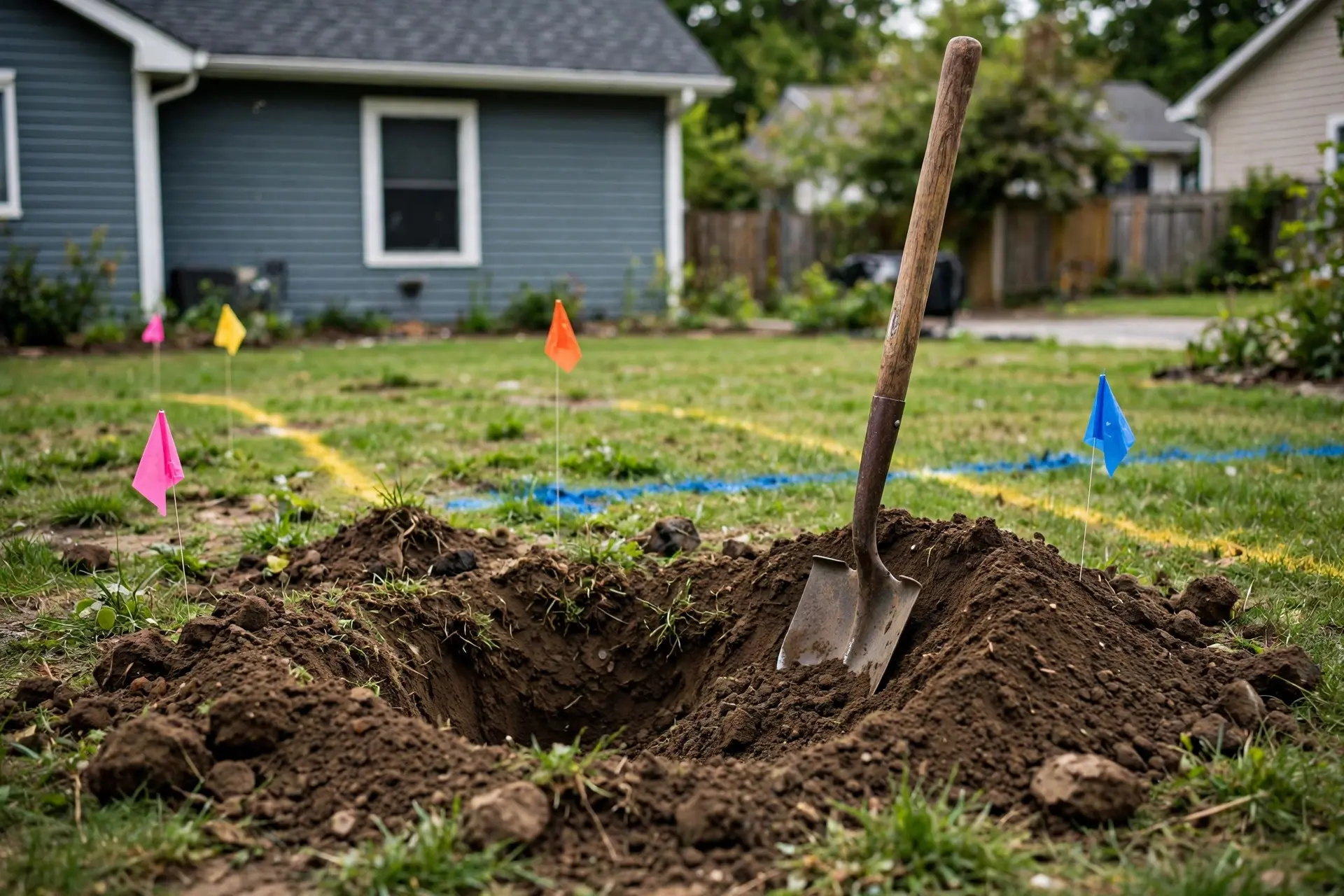
Keep trees at least 5 feet from any buried utility line, and increase that to 10 feet or more over sewer lines.
Sewer lines deserve extra respect because roots do not damage a sound pipe so much as exploit one that is already slightly loose or cracked at a joint. Water and nutrients leak out, roots find them, and then the roots grow into the gap. A slow drain years after planting is a classic symptom.
Before you dig anything deeper than a border, have utilities located. In the United States that means calling 811, which is free, and it takes a few days, so make the call before the weekend you planned to plant. Locating services mark electric, gas, water, communications and sewer where those are part of the public system. A private lateral or a septic field may not be marked, so check your own plot plan too.
Shrubs Against the Foundation
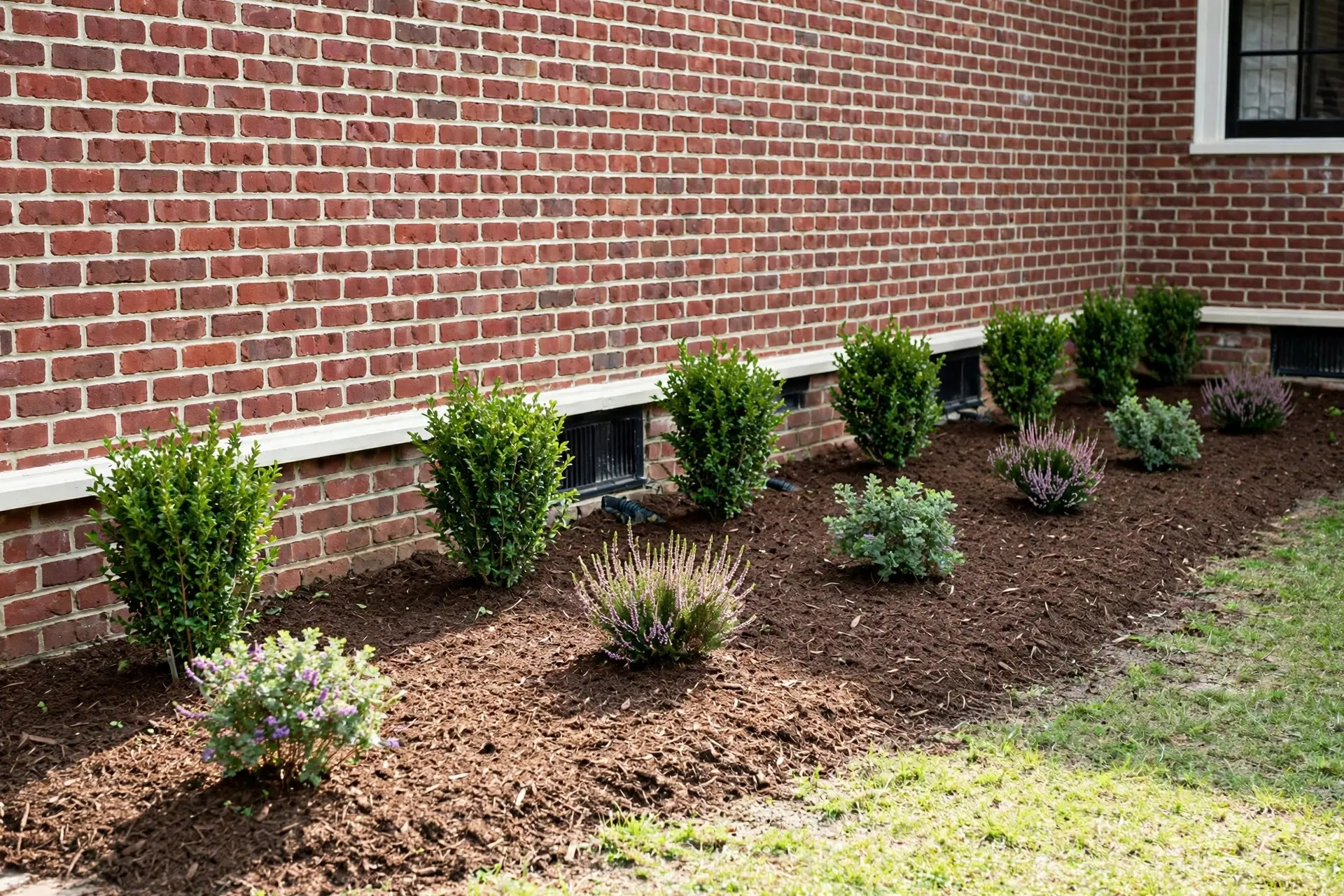
Foundation shrubs follow a different and much smaller rule: a minimum of 2 to 3 feet from the foundation, measured for the shrub’s mature width rather than the size of the pot it came in.
The arithmetic is straightforward. A shrub that matures at 4 feet wide reaches 2 feet in each direction from its center, so planting it 3 feet from the wall leaves about a foot of air between the foliage and the siding. That foot is the entire point.
Air circulation there does real work. Foliage pressed flat against siding traps moisture, and trapped moisture against wood or paint invites mildew and rot. It also blocks the drainage the foundation was designed to have, and it makes the wall impossible to inspect or repaint. While you are planning the bed, keep the soil graded to slope away from the house, because plant spacing and drainage are solving the same problem from two directions.
The classic overgrown foundation planting, where junipers have swallowed the front windows, is almost always a spacing decision made twenty years earlier, not a pruning failure.
What Actually Goes Wrong When Trees Sit Too Close
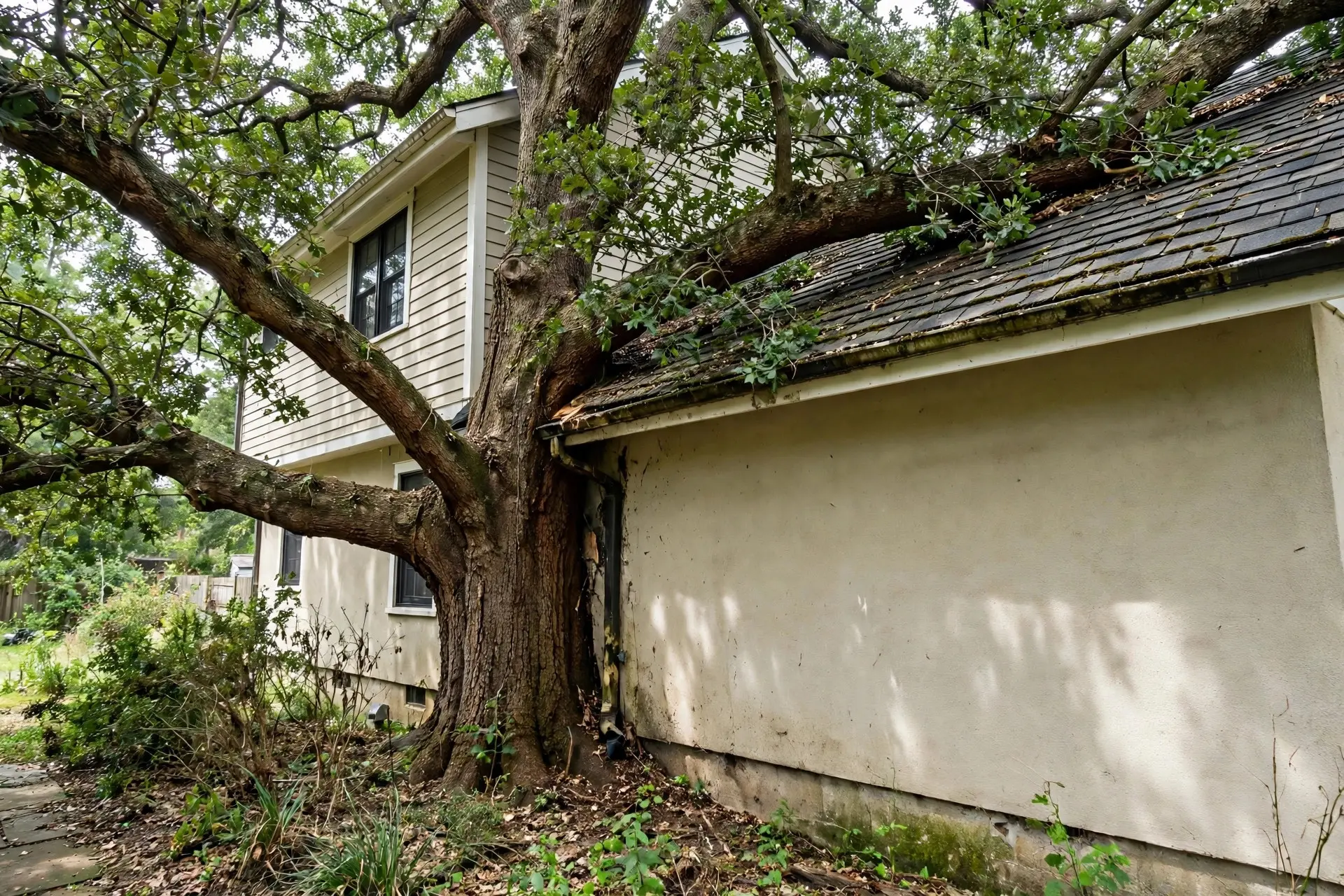
- Storm damage. The most immediate risk, and the reason for the mature height rule. A tree within its own height of the house can reach it when it falls.
- Moisture held against the building. Dense growth close to walls keeps siding and trim damp and invites mildew.
- Interference with foundation drainage. Roots and dense planting disrupt the water management the foundation relies on.
- Hardscape lifting. Driveways, paths and patios sit shallow and are the first casualties of a spreading root system. Path layout is worth planning alongside tree placement, and the same is true of garden path width.
- Gutters and roofs. A canopy overhanging the roof means leaf litter in the gutters every autumn and branches abrading shingles.
- Light and views. Nobody plans for this and everybody notices it. A tree 10 feet from a south facing window changes that room permanently.
A Checklist Before You Dig
- Read the tag for mature height and mature spread. Treat both as real numbers, not marketing.
- Call 811 or your local locating service and wait for the marks.
- Measure the distance to the wall, the nearest corner, the driveway, the path and the property line. Use the size category minimums above.
- Halve the mature spread and check that the root zone does not reach the foundation, the drive or a sewer line.
- Look up for overhead lines, including the service drop to your own roof.
- Check where the shade will land at the time of year you care about, and which windows it will cross.
- Mark the spot with a stake and leave it for a few days. Walking past it is how you notice the thing a tape measure misses.
- If the numbers do not work, change the tree rather than the distance.
Step eight is the one that matters. Almost every tree that had to be removed at twenty years old was planted by someone who decided the guideline was probably conservative.
Planting in Autumn
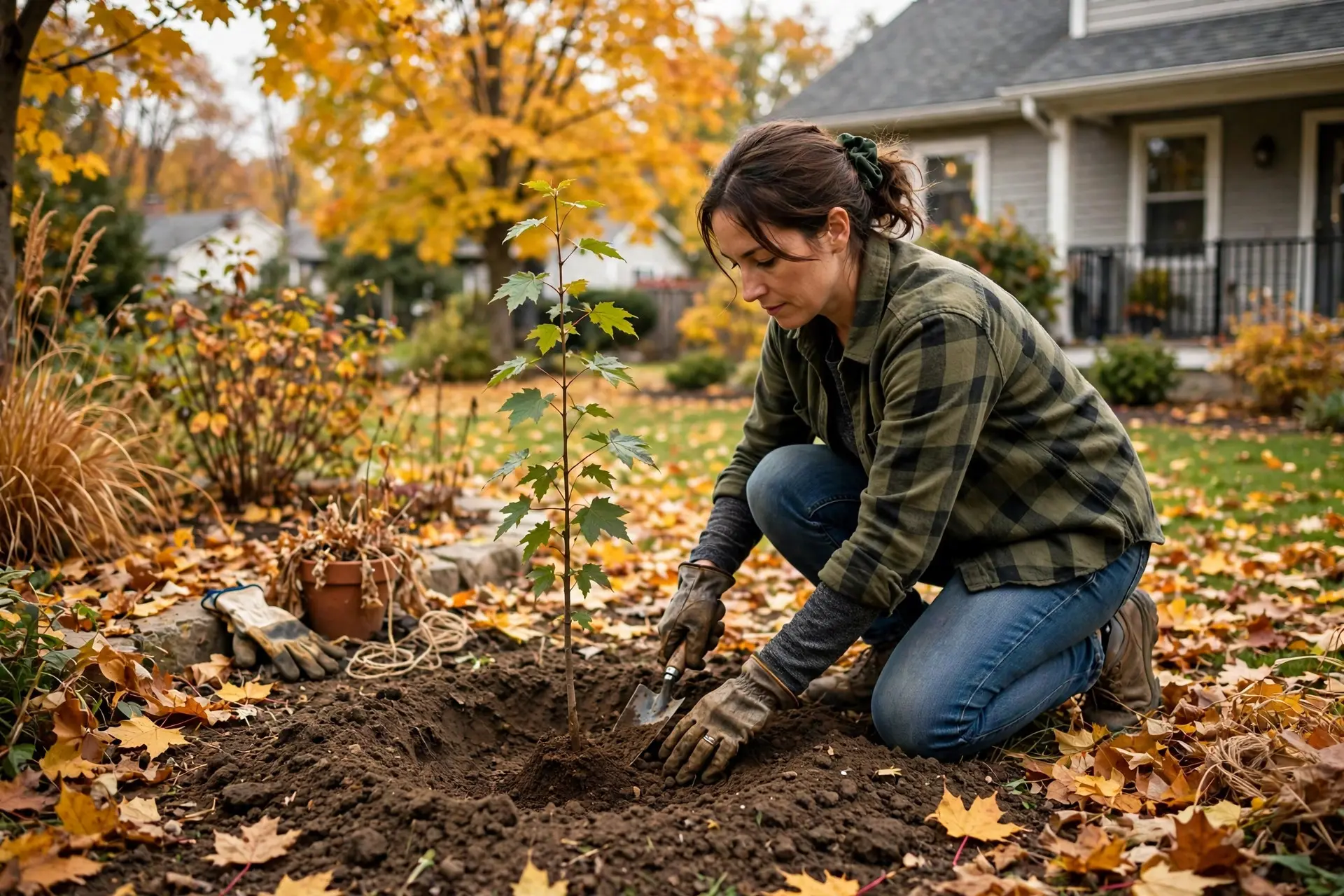
Autumn is a popular planting window because the soil is still warm while the air has cooled, so a young tree can put energy into roots rather than leaves. It pairs well with the rest of the seasonal list, and if you are already outside doing fall garden cleanup or fall bulb planting, it is an efficient time to get a tree in the ground.
Two practical notes. Do not amend the planting hole heavily with rich compost, because roots that find a pocket of luxury tend to circle inside it instead of pushing out into the native soil. And water deeply through the first autumn and the following summer, since a newly planted tree has a root system far smaller than its canopy suggests.
Quick Reference
- Ideal distance from the house: the tree’s mature height.
- Small tree, 25 feet or less: 8 to 10 feet from a wall, 6 to 8 feet from a corner.
- Medium tree, up to 40 feet: 15 feet from a wall, 12 feet from a corner.
- Large tree, over 40 feet: 20 feet from a wall, 15 feet from a corner.
- Same distances apply to driveways and sidewalks.
- Buried utility lines: at least 5 feet.
- Sewer lines: 10 feet or more.
- Under or within 20 feet of an overhead line: small trees only.
- Foundation shrubs: 2 to 3 feet from the wall, based on mature width.
- Root spread: assume roughly the same width as the mature canopy.
Frequently Asked Questions
How far should a tree be planted from a house?
At minimum, 8 to 10 feet for a small tree under 25 feet tall, 15 feet for a medium tree up to 40 feet, and 20 feet for anything larger. The ideal is to match the distance to the tree’s mature height, which keeps the house out of reach if the tree ever comes down.
Can tree roots damage a house foundation?
Roots close to a building can interfere with the drainage a foundation relies on and can intrude where there is already a weakness. In practice the more common problems are lifted driveways and paths, moisture trapped against siding, and sewer lines invaded through existing cracks. Respecting the distances above and keeping the root zone clear of the foundation avoids most of it.
How do I know how wide a tree’s roots will spread?
Use the mature canopy spread as your estimate, since lateral roots generally reach about as far as the branches. Halve that number to get the distance from the trunk in any one direction, then check it against the distance to your wall, driveway and pipes.
What trees are safe to plant close to a house?
Small species that mature at 25 feet or less, and narrow columnar forms whose canopy and root spread both stay tight. Dogwood, serviceberry and crepe myrtle are commonly recommended for close planting, and columnar cultivars work well in narrow side yards. Check the mature spread on the specific cultivar, since the same species can be sold in very different sizes.
How close to a driveway can I plant a tree?
Use the same distances as for a wall: 8 to 10 feet for small trees, 15 feet for medium, 20 feet for large. Driveways and sidewalks sit shallow, so they are usually the first thing a spreading root system lifts, and repairing concrete is more expensive than moving a sapling.
The Short Version
Read the tag, halve the mature spread, and check that number against the wall, the corner, the driveway and the pipes. Small trees at 8 to 10 feet, medium at 15, large at 20, with the tree’s mature height as the ideal. Then, if it does not fit, plant a smaller tree rather than shaving the distance. That one decision is the difference between a tree that improves the house for forty years and one that gets cut down at twenty. If you are planning the wider layout, these yard landscaping ideas help place the rest around it.