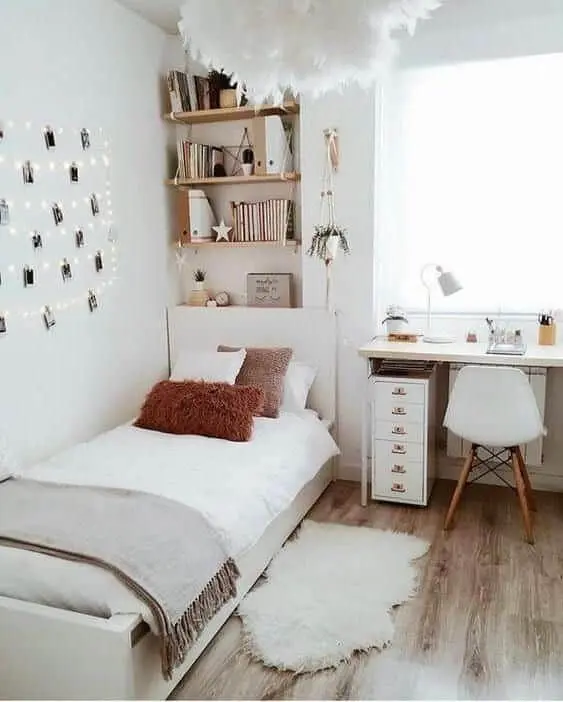
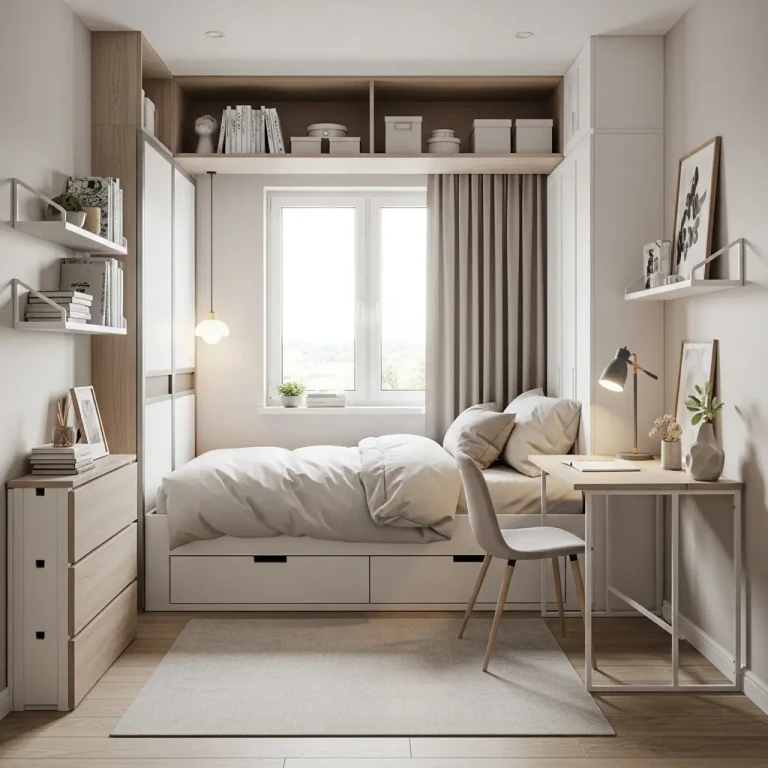
Bed Placement: Where to Put a Bed in Any Bedroom

Most people decide bed placement by pushing the bed against the biggest empty wall and hoping the rest of the room works itself out. Sometimes it does. More often you end up squeezing past the footboard, opening a closet door into the mattress, or waking up with morning sun directly in your face.
Good bed placement is mostly arithmetic with a few judgment calls on top. The bed is the largest object in the room, so wherever it goes determines every other decision. Here is how to figure out where to put a bed in a bedroom, starting with the clearances that rule out bad options before you waste an afternoon dragging furniture.
Start with clearances, not with the look
These are design practice numbers rather than building code, but they are the difference between a room that feels calm and one that feels like an obstacle course. Measure your room, then test each placement idea against them.
- 24 inches is the practical minimum along a side of the bed you need to walk down. You can pass through it sideways and make the bed without contorting.
- 30 to 36 inches is what a side path feels like when it is genuinely comfortable. This is where you want the main approach to the bed if you can get it.
- 30 inches at the foot of the bed if there is a walkway there, more if a dresser with drawers sits across from it, because an open drawer eats into the path.
- 36 inches for the primary route from the door to the bed, closet and bathroom.
- Full door swing plus a few inches for every door in the room. A 30 inch door needs a 30 inch arc kept clear, and closet doors count.
One side of a bed can drop to zero if the bed is against a wall and only one person sleeps in it. For two people, both sides need real access or one person climbs over the other every night. That sounds obvious written down and gets ignored constantly in small rooms.
If your mattress is not yet bought, settle size before placement. Our bed size guide covers which mattress actually fits which room, and it is far easier to size down than to rearrange around a bed that was always too big.
Which wall the bed belongs on
The default: the wall you see when you walk in
In most bedrooms the headboard belongs on the wall opposite or diagonal to the door. People sometimes frame this as a feng shui idea, the so called commanding position, but it holds up for plain practical reasons that have nothing to do with energy.
You can see who is coming in, which most people find settling whether or not they can explain why. The bed reads as the intentional focal point instead of something you edge around. And the door swing lands in open floor rather than against the mattress. That combination is why it works so often.
When the longest wall is the wrong answer
The instinct to use the longest wall is usually wrong in a rectangular room. Putting the headboard on a long wall means the bed projects into the narrow dimension, which is exactly where you have the least room to spare. Running the bed off a short wall lets the length of the bed use the length of the room.
Test both. Take your bed length, add the clearance you need at the foot, and see which orientation leaves a usable number. In a room that is 10 by 13, an 80 inch bed off the 10 foot wall uses 80 of 156 inches of length and leaves 76 inches for walking and furniture. Off the 13 foot wall it uses 80 of 120 inches and leaves 40. Same bed, very different room.
What to do about windows
A bed under a window is not a disaster, and plenty of beautiful bedrooms do it. But there are four real tradeoffs, and all four are solvable if you know about them first.
- Draft and temperature. Older single pane windows lose heat at the glass, and your head is the part of you that notices. A tall upholstered headboard largely fixes this.
- Curtains. Floor length panels and a mattress want the same square inches. Either mount the rod well above and wide of the window so the panels clear the bed, or switch to a roman shade or roller inside the opening.
- Light timing. A window at the head of the bed means direct sun on your face at whatever hour that wall faces. East facing is the brutal one. Blackout lining matters more here than anywhere else in the house.
- Condensation. On cold glass, moisture collects and runs down. Keep the headboard an inch or two off the wall so air moves, and keep bedding from touching the sill.
What you should not do is block an egress window. If the bedroom has only one window that serves as its emergency escape opening, the bed cannot obstruct access to it. That is a safety requirement rather than a style preference.
Centered on the wall, or pushed into a corner
Centering the bed on its wall is the safe choice and it is what makes a room look composed. It gives you symmetry, room for a nightstand on each side, and a balanced place to hang art.
Corner placement, with one long side against a wall, is the right call in genuinely small rooms. It buys you one large open area instead of two useless 15 inch strips. The cost is real though: you lose a nightstand, one person has to climb out over the other, and making the bed becomes a chore. If you go this route, use a single nightstand on the open side and skip the matching pair entirely rather than cramming a tiny table into the wall side where nobody can reach it.
There is a middle option worth knowing. Center the bed on its wall but accept uneven side clearances, say 30 inches on the approach side and 24 on the far side. Asymmetry you chose on purpose reads better than symmetry that leaves both sides too narrow.
Once the bed lands, the two pieces that finish the arrangement are the nightstands and the rug. Match surface height to mattress height using our guide to nightstand height, and get the rug overhang right with the placement rules in rug size for queen bed.
Sloped ceilings and awkward rooms
Attic and dormer bedrooms change the rules, because the usable wall is not where the wall is. Under a slope, put the bed where the ceiling is lowest. You are lying down there, so you need maybe 40 inches of height above the mattress and nothing more. Save the full height area for standing: the path, the closet, the dresser.
Measure the height at the exact point the headboard will sit, then measure again 30 inches out, which is roughly where you sit up in bed. That second number is the one that decides whether you hit your head every morning.
In rooms with a door and closet on the same wall, or two doors, the bed often has exactly one possible position and your job is to confirm it rather than choose it. Draw the door arcs on the floor with painter’s tape before moving anything. It takes five minutes and prevents the discovery that the closet no longer opens.
A worked example: queen bed in a 10 by 10 room
A 10 by 10 bedroom is 120 inches square. A queen mattress is 60 by 80 inches. Here is the whole arrangement in numbers.
- Headboard centered on one wall: 60 inch bed on a 120 inch wall leaves 30 inches on each side. That clears the 24 inch minimum comfortably.
- Two nightstands at 20 inches each: 60 plus 40 equals 100 inches, leaving 10 inches at each end of the wall. Workable.
- Running depth: 80 inches of bed leaves 40 inches from footboard to the opposite wall.
- Put an 18 inch deep dresser on that opposite wall and the walkway at the foot drops to 22 inches. Passable, but you cannot open a drawer and walk by at the same time.
So the honest conclusion for a 10 by 10 with a queen is that you get the bed, two nightstands and clear side access, or you get a dresser, but not comfortably all four. The usual fix is moving storage into the closet or choosing a narrower 14 inch deep chest. A full size mattress at 54 by 75 inches buys back six inches of width and five of length, which is often the real answer. For more ways to reclaim space in a tight room, see our small bedroom ideas.
Bed placement mistakes worth avoiding
- Blocking a heating or cooling vent with the bed or a long bed skirt. Check the floor before you commit.
- Putting the headboard on the wall shared with a bathroom or a neighbor. Plumbing noise travels through that wall better than any other.
- Choosing a position that puts an outlet behind the center of the headboard, where you can never reach it.
- Forgetting the ceiling fan. A bed under a fan is fine, but a bed under the edge of a fan in a low ceiling room means someone sits up into it.
- Floating the bed in the middle of a small room because it looked good in a photo of a much larger room.
Frequently asked questions
Where should you put a bed in a bedroom?
Against the wall opposite or diagonal to the door, centered if the wall allows it, with the bed running along the room’s longer dimension. Then confirm you have at least 24 inches on each side you need to walk down and a clear door swing. If both cannot be satisfied, a smaller mattress or corner placement is the tradeoff.
How much space do you need around a bed?
Plan on 24 inches minimum along any side you use, 30 to 36 inches for a side that feels comfortable, and 30 inches at the foot if there is a walkway there. Keep 36 inches for the main path between the door, the bed and the closet.
Is it bad to put a bed under a window?
Not inherently. You are managing draft, curtain conflict, early light and condensation, and a tall headboard plus the right window covering handles most of it. The one firm rule is that you cannot block access to a bedroom’s emergency escape window.
Should a bed go on the longest wall?
Usually not. Placing the headboard on a short wall lets the bed length run with the room length, which preserves the narrow dimension for walking. Run the numbers both ways before deciding, since the difference can be two or three feet of usable floor.
Can a bed go in front of a door or closet?
No for a door, and almost never for a closet. Tape the door arcs on the floor first. A bed that partially blocks a bifold closet will seem survivable for about a week and then become the thing you hate about the room.
The short version
Measure the room, then test placements against the clearance numbers instead of guessing. Default to the wall opposite the door, run the bed with the room’s length rather than across it, keep 24 inches minimum on every side you use, and tape out the door swings before you move a single thing. If no arrangement clears those numbers, the room is telling you the mattress is one size too big, and that is useful information rather than a failure.