

Most fall wreaths fail for the same two reasons. They have too many things on them, and they were built for a photograph rather than for a door that faces weather.
A good one is simpler than you expect. It usually has two or three materials, it repeats them in a rhythm, and it is scaled to the door instead of to the shop shelf. Get those three things right and a fifteen dollar wreath base can look like a florist made it.
The fall wreath ideas below are organized by the base you start with, because that decision shapes everything that comes after it.
Scale first, because this is the most common mistake

A wreath that is too small is the fastest way to make a nice front door look slightly sad. It happens constantly, because wreaths look big in your hands and small on a door.
A workable guide: aim for a wreath diameter of roughly half to two thirds the width of your door. On a standard 36 inch door, that means somewhere between 20 and 24 inches. Most people default to 18 inches, which is why so many doors look under dressed.
If you have a double door, treat it as one surface. Two matching wreaths hung at the same height read as intentional. One wreath on one half looks like something is missing.
And if you have a glass storm door in front, measure the gap. Anything thicker than about three inches will press against the glass, crush on one side, and never recover its shape.
The three material rule

This is the single idea that separates expensive looking wreaths from craft store looking wreaths.
Pick three materials maximum. One dominant, one supporting, one accent. Repeat them around the wreath rather than scattering one of everything.
A wreath with eucalyptus, dried wheat, and one cluster of dried orange slices looks designed. A wreath with eucalyptus, wheat, orange slices, pumpkins, berries, pine cones, plaid ribbon, and a bird looks like a clearance bin. Same materials, different discipline.
When in doubt, subtract. A base plus one repeated element and one focal point is usually enough.
Fall wreath ideas by base



The grapevine base
The most forgiving and the best value. Bare grapevine already looks like autumn, so you need very little on it.
Try a grapevine ring with a loose cluster of dried hydrangea on the lower left and nothing else. Or a few stems of preserved eucalyptus wired along one side, leaving two thirds of the vine exposed. The asymmetry is what makes it look styled rather than store bought.
Grapevine also handles wind and rain well, which makes it the practical choice for an exposed door.
The magnolia leaf wreath
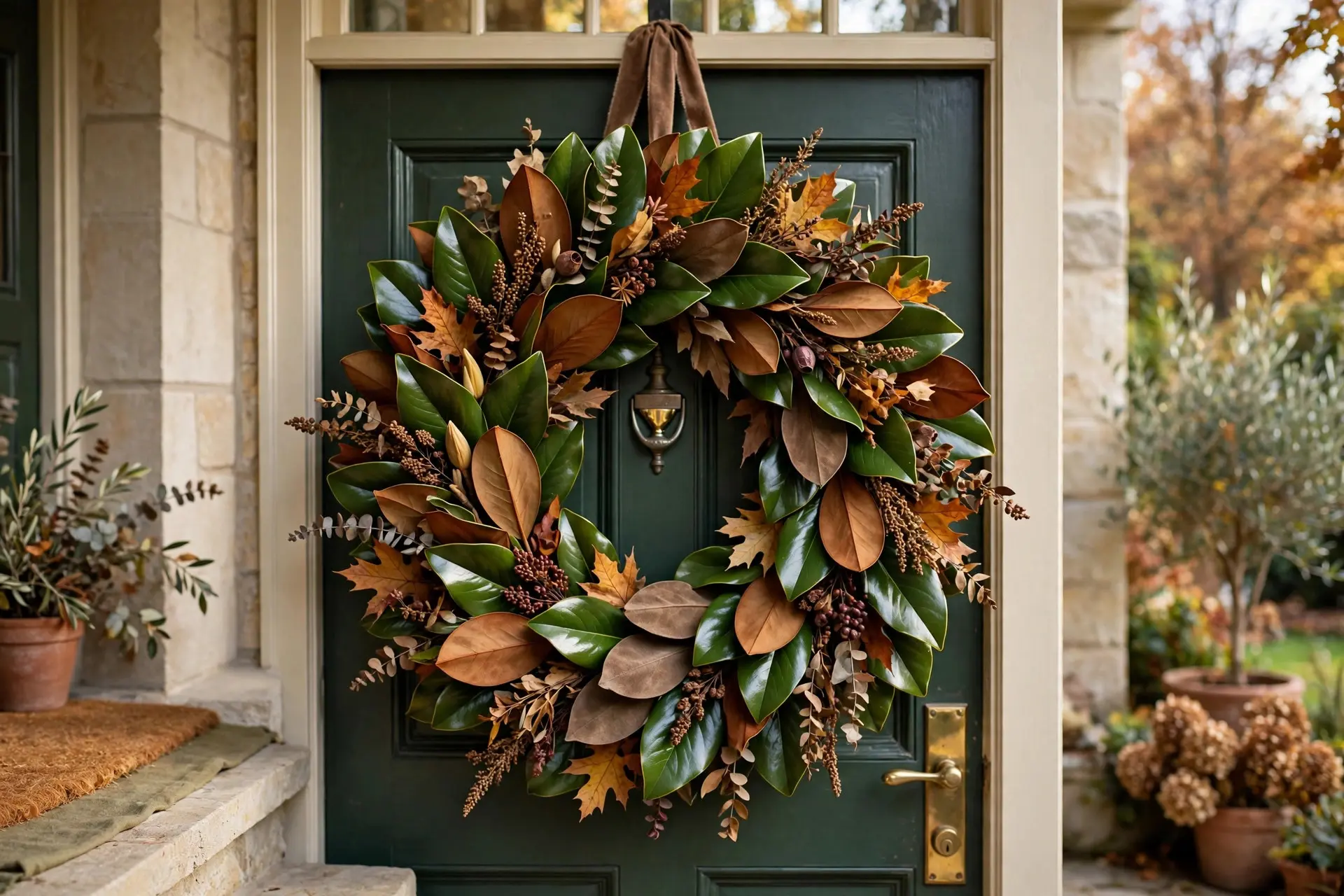
Preserved magnolia is the quiet workhorse of autumn door decor. Green side out reads fresh and current. Flipped to show the brown, suede-like underside, it becomes unmistakably fall without a single pumpkin.
It costs more up front and lasts years if stored flat and out of sunlight. If you want one wreath that carries from September through to the holidays with just a ribbon change, this is it.
Dried and preserved florals
Pampas, bunny tails, dried wheat, bleached ruscus, preserved ferns, and dried hydrangea. This is the look that dominates autumn feeds, and for good reason. It is soft, textural, and photographs beautifully.
The honest limitation: dried material hates moisture and direct sun. A dried wreath on a sheltered door under a deep porch will last two seasons. The same wreath on a west facing door with no cover will go brittle and faded by November. Know which door you have before you spend.
If you enjoy working with dried stems, our guide to floral arrangements covers the same balance and proportion principles applied indoors.
Wheat and grass wreaths
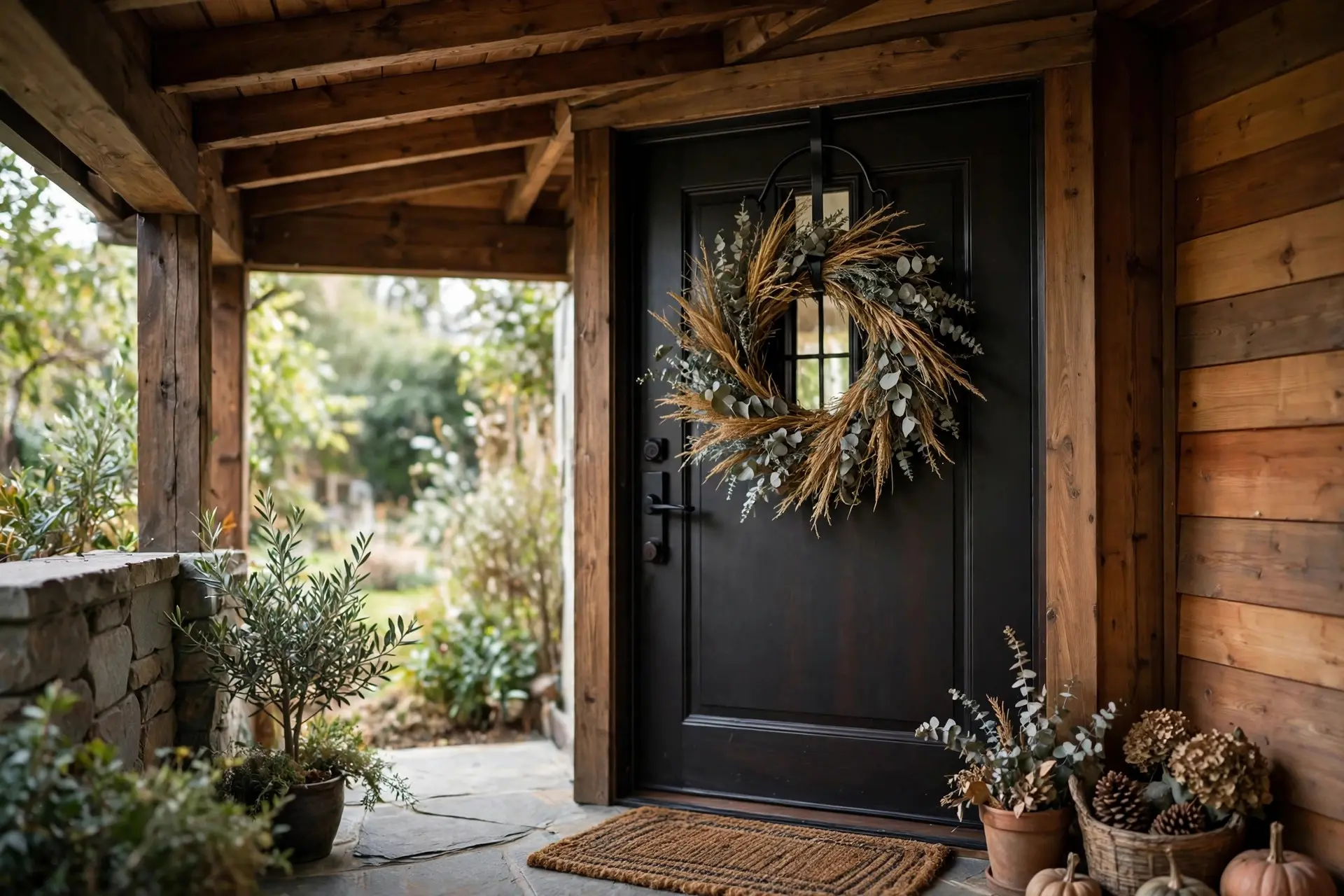
A full ring of wheat, all stems pointing the same direction, is one of the most elegant fall wreaths there is, and one of the cheapest to make. The repetition does all the work. Nothing else needs adding.
This one looks particularly good on a dark painted door, where the pale gold reads almost like a halo.
Faux foliage, chosen carefully
Good faux has come a long way. The tell is almost never the leaf shape, it is the finish. Shiny plastic leaves and uniformly perfect colour are what give it away.
Look for matte surfaces, colour variation within a single leaf, and visible stem texture. One well made faux stem repeated eight times beats a mixed bag of cheap ones. Faux is also the right answer for a fully exposed door, since it does not care about rain.
The foraged wreath
A wire ring, floral wire, and whatever your neighbourhood is dropping in late September. Oak leaves, seed heads, rosehips, dried grasses, small bare branches.
This is the cheapest and most personal option, and it looks better than it has any right to. Two notes: let foraged material dry for a few days before wiring so it does not shrink away from the frame, and check anything you cut is from your own garden or public land where foraging is allowed.
The minimalist alternative
Not every door wants a wreath. A dried wheat bundle tied with linen ribbon and hung vertically, a small branch wrapped in a hoop, or a single eucalyptus swag across the top of the door all do the job with less. On a modern or very simple facade, these often look better than a traditional round wreath.
Colour, and how to pick yours

The fastest way to a wreath that looks considered is to stop thinking in autumn cliches and start from your door colour.
- Dark green, navy, or black door: pale and dried tones. Wheat, bleached ruscus, cream hydrangea, pampas. The contrast does the work.
- White or cream door: deeper, warmer material. Rust, burgundy, dark magnolia, bronze foliage. Pale on pale disappears.
- Warm wood door: greens and muted sage. Olive, eucalyptus, preserved fern. Avoid orange, which competes with the wood.
- Red or bright door: keep the wreath almost entirely neutral. The door is already the colour.
The broader palette running through autumn decor right now leans warm and muted rather than bright. Rust rather than pumpkin orange, ochre rather than yellow, dusty burgundy rather than red, with plenty of cream and dried green in between. Our fall home decor guide goes further into that palette if you are carrying it indoors.
Making it last on a real door
A few things genuinely extend a wreath’s life:
- Hang it under cover where possible. A porch overhang is worth more than any sealant.
- Avoid direct afternoon sun. Sun fades dried and faux material faster than rain damages it.
- Use a proper wreath hanger or a ribbon loop over the door rather than a nail through the frame. It also lets you lift it off quickly when a storm is coming.
- Bring it in during heavy weather if it contains dried material. Two minutes of effort buys a whole extra season.
- Store it flat, not hanging, in a paper bag or box rather than plastic. Hanging storage flattens one side, and plastic traps moisture.
- Refresh instead of replacing. Swap the ribbon, add three new stems, and last year’s wreath looks new.
Beyond the front door
Wreaths work in more places than people use them.
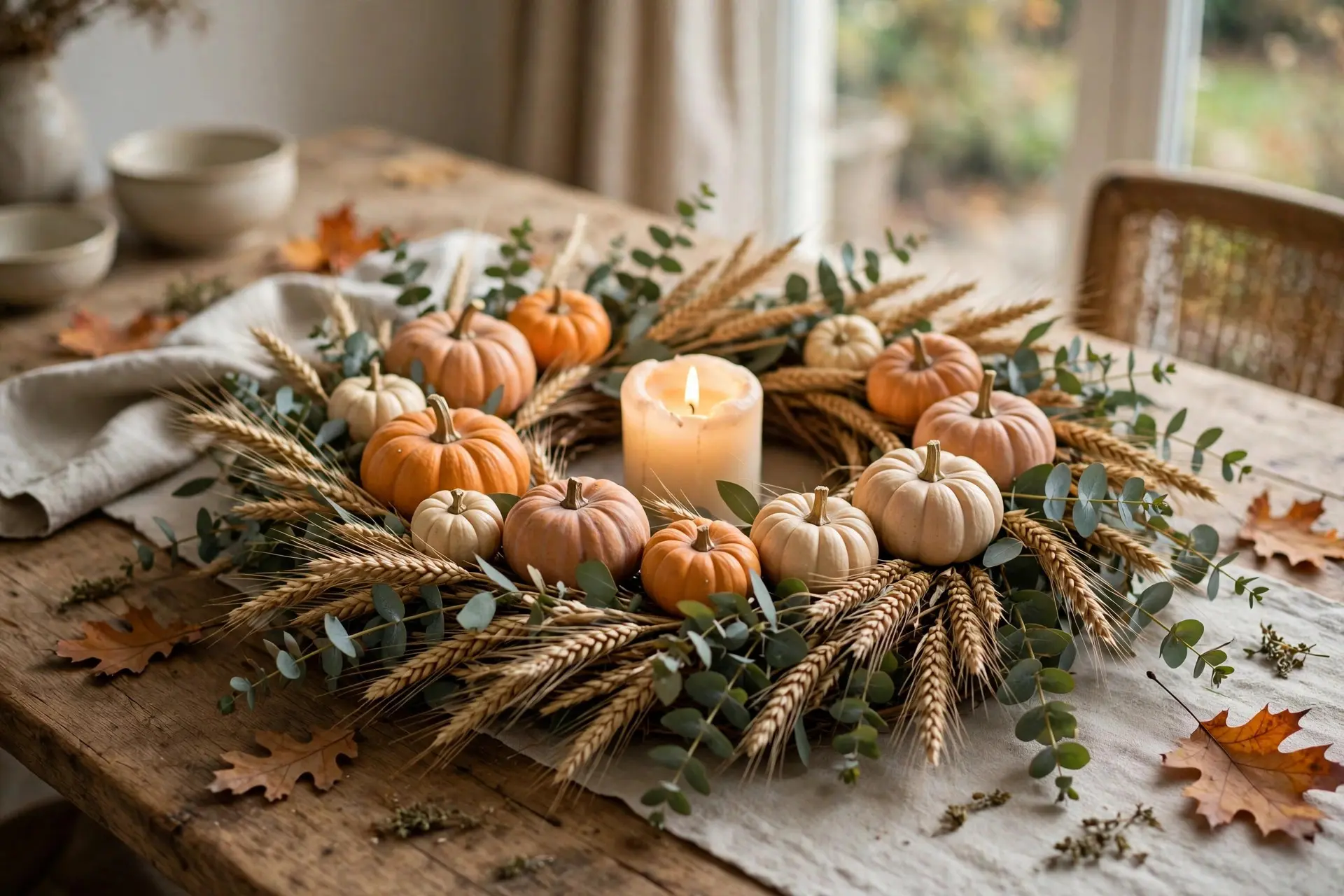
Hang a small one on the back of a dining chair for a seasonal table, or on a kitchen cabinet door, or over a mirror in the entryway. A wreath laid flat on a dining table with a candle or a small bowl in the centre makes an instant centrepiece with no arranging skill required.
Inside a window, facing out, is a quietly lovely option for homes where an exterior wreath is not practical. And a wreath hung on an interior door at the end of a hallway gives a dark corridor something to look at.
If you are planning the whole entry, our front porch decor ideas guide covers how the wreath works alongside planters, doormats, and lighting.
Frequently asked questions
What size wreath fits a standard front door?
Aim for roughly half to two thirds the door width. On a typical 36 inch door that is 20 to 24 inches. Going smaller than 18 inches tends to look under scaled unless the door itself is narrow.
When should you put up a fall wreath?
Early to mid September works well for a neutral, dried, or foliage based wreath, since it reads as seasonal rather than as a specific holiday. Save pumpkins and obvious harvest motifs for October if you want the wreath to last the whole season without feeling early.
How do you keep a fall wreath from fading?
Keep it out of direct afternoon sun, which does more damage than rain. A sheltered door, a north facing door, or a deep porch overhang all help. Rotating the wreath a quarter turn every few weeks also evens out any fading.
Can a fall wreath work through Thanksgiving?
A neutral one can, easily. Wheat, magnolia, dried grasses, and muted foliage all carry through November without looking out of place. Swap the ribbon for something deeper and it feels like a different wreath. Our Thanksgiving decor ideas guide has more on bridging the two.
Is it cheaper to make or buy a fall wreath?
Making is cheaper if you start from a grapevine or wire base and buy three types of stem, and the result usually looks better because you control the proportions. Buying makes sense for preserved magnolia and good quality faux, where the material cost dominates anyway.
The short version
Measure your door and go bigger than instinct suggests. Choose three materials and repeat them. Start your colour choice from the door, not from the season. Then hang it somewhere sheltered and lift it off when a storm comes.
That is the whole thing. The simplest wreath, correctly scaled, beats an elaborate one every time.